Historically speaking
On the wings of memory
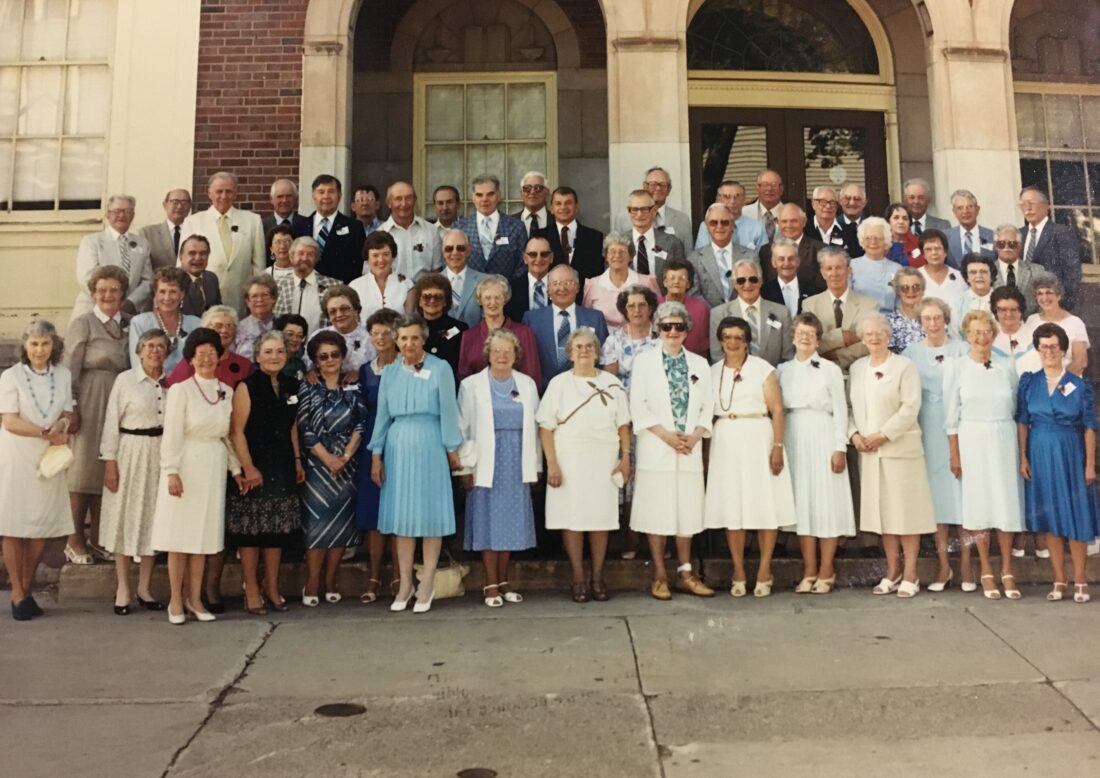
The Negaunee High School Class of 1937, on the occasion of its 50th reunion. (Photo courtesy of the Negaunee Historical Society)
NEGAUNEE — On the wings of memory is an article I found in the files at the museum. It is a letter that someone wrote to their classmates on the anniversary of their 50th class reunion.
There is no name attached to it but I thought at this time of class reunions, I would share some parts of it because it is a fun read.
World War I had just been fought, the armistice had been signed, the flu epidemic of 1918 had run its course. It was in this setting that we the class of 1937 were ushered into life.
Mother was always at home baking bread, cakes (no mixes) and cookies. How did mothers know how much wood to feed the stove to produce 375 degrees? Vegetables were grown and canned and stored in the cellar.
When death took a family member, it was prepared for burial and it was in the home where family members and friends kept vigil until the funeral. Water for the family wash was heated in a boiler, clothes were rinsed in bluing and hung out to dry in the summer sun and freeze in the winter. Fathers worked long, hard hours in the mine. A pint of ice cream was bought on payday, one pint for five people seems meager but it was adequate then.
Doctors made house calls. Radio and TV and stereos we knew not, but we knew how to toboggan down Lucy Hill, play checkers and Old Maid. Our lawn provided the setting for “pump, pump, pull away,” “drop the hankie” and “farmer in the dell.” Remember picnicking with a red checkered tablecloth, no plastics, no paper plates.
Our mothers made dresses on a Singer treadle sewing machine. When garments were “unrepairable” they were cut into rags, sewed together, wound into huge balls and woven into carpets. Recycling, you bet! Now that I have retired, I cut coupons for bonus shopping, but I do not recall coupons in the early years but there were other bonuses, tucked inside the Quaker oatmeal box was a piece of carnival glass.
At Collin’s market, a soup bone with extra meat on it was thrown in free with the Sunday roast. Spring cleaning meant washing the curtains in boiling water and starch and pinned to the curtain stretchers and put out in the sun to dry.
The parlor rug was hung over the line and beaten with a wire rug beater. Heavy mattresses were put onto the saw horses and got the same treatment. I took “cooking” under the watchful eye of Miss Thrathen,she was explicit in her measurements and methods.
Not so with my grandmother. When I asked her to teach me how to make bread she said it’s easy, “just make a sponge,, add sugar, molasses and syrup, then add flour to make a stiff dough. Grandma’s cookbook instructions were a “pinch of salt,” soda to cover a dime, butter the size of an egg, a coffee cup of milk running over, and about 10 cents worth of nuts. Never run or jump in the kitchen when the cake is baking because it might fall.
A straw was pulled from the broom to test the doneness of the cake, if the straw came out dry the cake was done. Remember the gossip of short skirts, women showing their legs in public. hair was no longer worn in a bun on top of your head and then there were those first permanents. We didn’t have indoor plumbing in the early years, the outhouse had three holes, large medium and small to accomodate all sizes.
Catalogues were recycled in here. In 1929, the banks failed and then the Great Depression. When knitted socks were too worn to be mended; they were unraveled and re-knit. Miners worked one or two days a week. We were poor and didn’t know it. Remember our autograph books?
Make new friends but keep the old, one is silver the other gold. Remember the gypsies, they would pass through town often camping at Jackson Park, we were warned that they kidnap and steal.
The Ku Klux Klan burned the cross at Suess Field east of town. And the hoboses traveling in box cars waiting for the next train. Most homes had a piano and many nights were spent singing old songs, there was church and choir, piano lessons were 25 cents for a half hour.
There were movies and I went with my grandmother to help her read the caption, later sound was introduced. Paul Bennett played the organ at the Vista as a prelude to the movie. Music of the era was, “My Old Kentucky Home,” “When Johnny Comes Marching Home Again,” “There Once Was an Indian Maid.”
We memorized “In Flanders Field” and Paul Revere’s “Ride.” On Armistice Day, Nov. 11, we stood as a class at 11 a.m. when the bells tolled, facing the east for one minute remembering the sacrifices made for our freedom.
Our superintendent was Mr. Doolittle. Athletics were always important to us. The band marched from the high school to the football field playing Sousa marches.
When the varsity won the state championship in 1930 under Coach Shadford we were in the 5th grade and one of our classmates stood on his desk and said “rah rah” “rah'” Negaunee and Miss McAuliffe who wanted us to grow up properly put an end to our revelry.
That student became a respected leader, Dr. Tom Mudge. Our teachers, our classmates, our study hall, each of us cherish our own memories, some good some not so good, but life went on until graduation day in 1937 when we marched down the aisle of the study hall to the strains of “Pomp and Circumstance” 50 years ago.
West End
Remembering old businesses
Historically speaking – classic
Historically Speaking
Christmas was spectacular in one small corner of Marquette County
Peter Pan and Tinker Bell glide along the ceiling rafters. Captain Hook grimaces from a darker corner. Sylvester ...
Historically speaking classic