
Sobriety court offers alternative to jail in Dickinson County
Trending
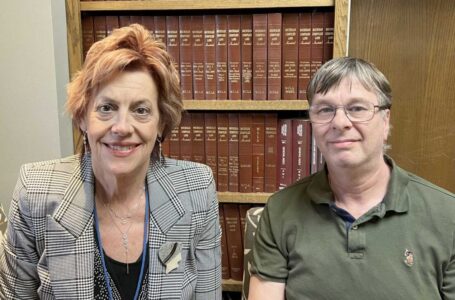
95B Dickinson County District Court Judge Julie LaCost, left, and Kevin Frievalt, Dickinson County Sobriety Court coordinator/deputy clerk, recently attended a conference in Grand Rapids sponsored by the Michigan Association of Treatment Court Professionals. The Dickinson County Sobriety Court delivers comprehensive treatment and rehabilitative services for nonviolent alcohol/drug offenders. (Photo via The Iron Mountain Daily News)
The Sobriety Court consists of intensive supervision, drug testing and monitoring, and various counseling components to achieve successful treatment outcomes.
Sobriety courts embrace the premise that addiction is a disease process that can be treated through an individualized approach that will provide a pathway to personal success and will reduce criminal behavior, said Kevin Frievalt , Dickinson Sobriety Court coordinator.
"Drug/sobriety courts are an innovative alternative to incarceration with emphasis on accountability and intensive monitoring for individuals charged with drug or alcohol related offenses and are open to any defendant that has any kind of substance abuse disease," Frievalt said. "The Drug Court removes defendants from the clogged courtrooms of the traditional criminal justice system, placing them in a new type of courtroom environment where they undergo treatment and counseling, submit to frequent and random drug testing, make regular appearances before the judge, and are monitored closely for program compliance."
Drug/sobriety courts focus on high risk/high needs individuals. Usually, participants complete inpatient treatment and upon discharge, begin participation in Sobriety Court. The program typically lasts 18 months.
Usually, an individual receives some degree of leniency in the court system by successfully completing the program.
While drug/sobriety courts vary widely in scope, organization, and points of intervention, all share an underlying premise that drug/alcohol use is not simply a law enforcement or criminal justice problem, but a public health problem with roots deep in society.
Drug/sobriety court programs see the court, specifically the judge, as filling a role that goes beyond that of adjudication.
Recently, Frievalt and Dickinson County District Court Judge Julie LaCost attended a conference sponsored by the Michigan Association of Treatment Court Professionals. The conference was held at DeVos Place in Grand Rapids
More than 800 people were in attendance of varying professions and backgrounds.
Attendees included treatment court judges, probation officers, attorneys, mental health therapists, substance abuse counselors, peer support persons, and other professionals involved in the court system.
Various topics and workshops were offered over the two-day conference. Subjects included:
≤ Community supervision in treatment courts.
≤ Treatment interventions for clients experiencing intense, negative emotions.
≤ Peer coaching as part of an integrated treatment plan.
For more information, please contact Frievalt at the 95B District Court at 906-774-0506.