
Celebrating student scholarship
NMU students display academic projects
Trending
MARQUETTE -- Microplastics in Lake Superior, the impact of financial stressors on mental health, and comparison of methods for DNA barcoding were just a few student projects on display at Thursday's 26th Annual "Celebration of Student Scholarship" held at Northern Michigan University.
The annual event, held this year at Harden Hall and the Lydia M. Olson Library, recognizes the academic contributions of undergraduate and graduate students in all disciplines. Students share their work with the NMU and Marquette communities by presenting research posters, recording oral presentations, and submitting creative written work as well as and artwork.
Interim President Kerri Schuiling addressed students and faculty during Thursday's opening ceremony.
"This event is one of the annual events at Northern Michigan University that really demonstrates why we all here," said Schuiling, who noted it also is fundamental to NMU's mission.
Schuiling also believes the "Celebration of Student Scholarship" has far-reaching effects.
"The research that you learn as undergraduates will do you well in all facets," Schuiling said.
That, she noted, includes thinking through things and looking at them from all sides.
"Clearly, the students who share their projects demonstrate their initiative and their innovation, and they have made the most of the opportunities presented in their academic programs," Schuiling said.
She said the projects covered an "amazing" range of topics, such as health care, public policy, social change and creative writing.
Schuiling also credited faculty advisers who mentored the students.
"They bring students into their labs," she said. "They bring students into their studios, digital spaces. Sometimes they bring them into their homes for gatherings, and they participate in this process of scholarship. It's a partnership."
Lisa Eckert, dean of the College of Graduate Studies and Research, pointed out that this event was a hybrid that included a digital format, not knowing what the COVID-19 pandemic would play out.
As a result, some student work was displayed at Harden Hall while other work was displayed at the NMU Commons.
"Being here demonstrates the resilience that we've had throughout this pandemic," Eckert said.
Students and faculty were noted during the Thursday ceremony.
Aleah N. Edwards and Philip Yangyuoru took first place in the undergraduate upper division for "Development of a Nucleic Acid Based Fluorescence ATP Biosensors." Second place went to Ryan C. Heines and Jill Leonard for "Importance of Reference Points in Orientation in a Current by Juvenile Mummichog." Annika Desai took third place for "Passing Through Beringia: Enhanced Sampling Resolves the History of Intercontinental Dispersal."
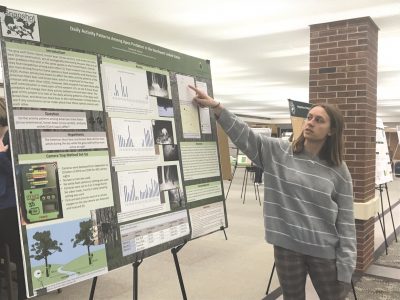
In the undergraduate lower division, Sydney M. Romps won for "Daily Activity Patterns Among Apex Predators in the Northwest United States. Second place went to Bianca Wiegerink for "Effect of Rearing Container Volume on Rotifer Colony Success," while third place went to Mia J. Strazny, Robert J. Belton Jr. and Amy Abel for "Genetic Analysis of CRISPR/cas9 Basigin Knockout T98 Glioblastoma Clones."
In the graduate category, Justin A. Pinero and Diana Lafferty's "Plasma and fecal cortisol metabolite concentrations following an ACTH challenge in captive brown bears" took the top spot. Nahir Negron-Fernandez and Ian Koskinen earned second place for "Ischemic Preconditioning Improves Time Until Failure During Rock Climbing Specific Tasks." Taking third place was Laura Whipple and Diana Lafferty for "Integration of Multiple Datasets to Evaluate Red Fox Distribution."
Winning the group category were Nadia S. Finley, Lorie L. Thompson, Shannon A. Ehrlich and Kendall J. Phillips for "Ecological Impacts of Invasive Species." Samantha Nelson and Madison Eddy earned second place for "Bystanders' Ability to Provide High Quality CPR Through Fatigue." Third place went to Grace Krajenka, Mackenzie Jonas, Aaron Busiel and Jordon Brown for "Lake Superior Drowning in Microplastics."
Romps explained her exhibit, which dealt with daily activity patterns among gray wolves, black bears and brown bears around Idaho, Montana and Wyoming.
"I just wanted to look at whether their activity patterns change around each other or not," said Romps, who noted they inhabit the same area. "They all eat kind of the same things. They're all pretty big predators, so them being in the space together, they're going to compete a lot."
She discovered that a wolf is nocturnal and the brown bear is crepuscular -- coming out at sunrise and sunset. The black bear also is crepuscular, but it emerges about an hour earlier than a brown bear.
"I did find that they had different activity patterns," Romps said.
However, she indicated that it's unknown whether those patterns are around each other or around humans.
"Future research could look into how they change around other rather than just seeing the different activity patterns," she said.
Recorded oral presentations, creative written work and artwork are avvailable at nmu.edu/studentcelebration.