
NMU forum addresses critical race theory
Trending
MARQUETTE -- Critical race theory is a polarizing issue with, it appears, no easy answers on whether it belongs in schools and universities.
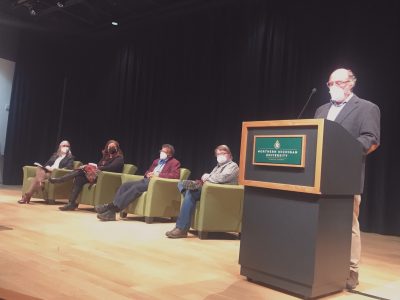
To delve deeper into this issue, the Beaumier U.P. Heritage Center at Northern Michigan University hosted a Feb. 17 forum at Jamrich Hall on CRT featuring four faculty members.
Moderating the forum was center Director Dan Truckey.
Truckey said that in November, the Michigan House of Representatives passed HB 5097, which would ban, in schools' core academic curricula, anything resembling race or gender stereotyping.
The vote, he noted, was 55-0, with Democrats refusing to vote because they were not allowed to comment on the House floor.
"The topics that fell under that definition that would be banned were: that individuals act in certain ways or hold certain opinions because of their race or gender, that racism is inherent in individuals from (a) particular race or ethnic group or that sexism is inherent in individuals from a particular gender, and also that actions of individuals serve as indictment against the race or gender of those individuals," Truckey said.
On the surface, that looks fine; after all, he said people should not be stereotyped.
Soon afterward, the Michigan Senate started to consider another bill, an extension of the House bill, Truckey said. That legislation, SB 460, has been approved by a Senate committee and was to go on to the Senate floor.
The bill, he said, would ensure that curricula provided to all students enrolled in a public school district or academy does not include coverage of CRT, he said, including several "anti-American" theories -- such as the U.S. being a "fundamentally" racist country.
"When we think about this bill that is currently being presented to the state for approval, one really can't not be alarmed by the inherent vagueness of the language," Truckey said. "You have to ask yourself: How could such laws even be enforced? Who determines what critical race theory is, and how or whether it is being taught in our schools?"
Oklahoma and Texas have banned critical race theory concepts from public schools, The Associated Press reported in a recent article. Kansas lawmakers are considering similar legislation as are legislators in Ohio.
The purpose of the forum, Truckey stressed, was to inform people about CRT, how it is used in academia, and its possible strengths and weaknesses as a school of thought.
Taking part in the forum were: Lesley Larkin, professor of English and author; Meghan McCune, assistant professor of anthropology; Alan Willis, professor of history; and Carter Wilson, professor and head of the Department of Political Science & Public Administration.
"I've been somewhat surprised to find that the relatively niche academic field of critical race theory has become the object of widespread public attention, legislative restriction and moral panic," Larkin said.
She called the phrase "critical race theory" a stand-in, and in literary studies, a metonym, for any approach to race that is critical, or "any approach that encourages critical thinking about race, is critical of the racial status quo or exposes the racial thought lines in our national mythologies."
Larkin added, "Although the movement against CRT is our schools is based on a fiction -- the fiction that CRT is being taught in our schools -- like race itself, it's a fiction with real-world consequences."
The real object of concern, she said, is the discussion of race itself, as if drawing attention to issues of race is tantamount to being racist.
"There are real problems that require real solutions in our society, but it's hard to get to those solutions if we limit what we can talk about," Larkin said.
McCune, who studies racism, said she uses CRT.
"It definitely informs the work that I do," she said.
What gets lost in the discussion about CRT, she pointed out, is that social class, gender and sexual orientation matter a lot as well.
She said people need to see how class, gender, religion, educational status and other issues affect individual experiences,
McCune stressed that she cannot teach her discipline or conduct research without CRT.
"It really helps," McCune said. "It's a nice lens -- and especially applied with some others, right? -- to understanding our social reality."
Willis said the evidence that race and racism has shaped American institutions is overwhelming.
"If you took an honest assessment of the situation, how could you miss it?" he asked.
Willis mentioned a bill proposed in South Carolina that would forbid students to be instructed with respect to the relationship to American values -- that slavery and racism are anything other than deviations, betrayals or failures to live up to, the authentic founding principles of the U.S., which include liberty and equality.
If it passes, he indicated that the law would prohibit teaching the possibility that white supremacy was "so interwoven into the fabric of American society" in the late 1700s and later that it was as authentic a part of the founding generations' beliefs as were the "enlightened ideals of liberty and equality."
Simply deeming one side inauthentic does not help people understand the "interplay," Willis said.
"I would say that laws that declare a particular narrative of history to be correct can't undo the realities of history," he said. "They can only attempt to hide it from a generation of schoolchildren.
Those laws, Willis said, will not help society move forward and address the problems of systemic racism.
Carter expressed strong opinions on the subject, saying CRT-related laws "dumb down" the curricula of public schools.
"They are based on lies and 'devil speak,'" he said. "They constitute a form of state censorship and indoctrination. They emerge as part of a larger reactionary political movement.
"Insofar as an informed and educated populace is the bedrock of a democratic society, these laws are a direct threat to our democratic society."
One of the criticism of CRT is that it will divide society, Truckey said.
When instructors and faculty talk about these issues, they are broadening students' minds, Carter said.
"My experience is that I speak to appreciate that," he said.