
What’s Flying: More of the unexpected
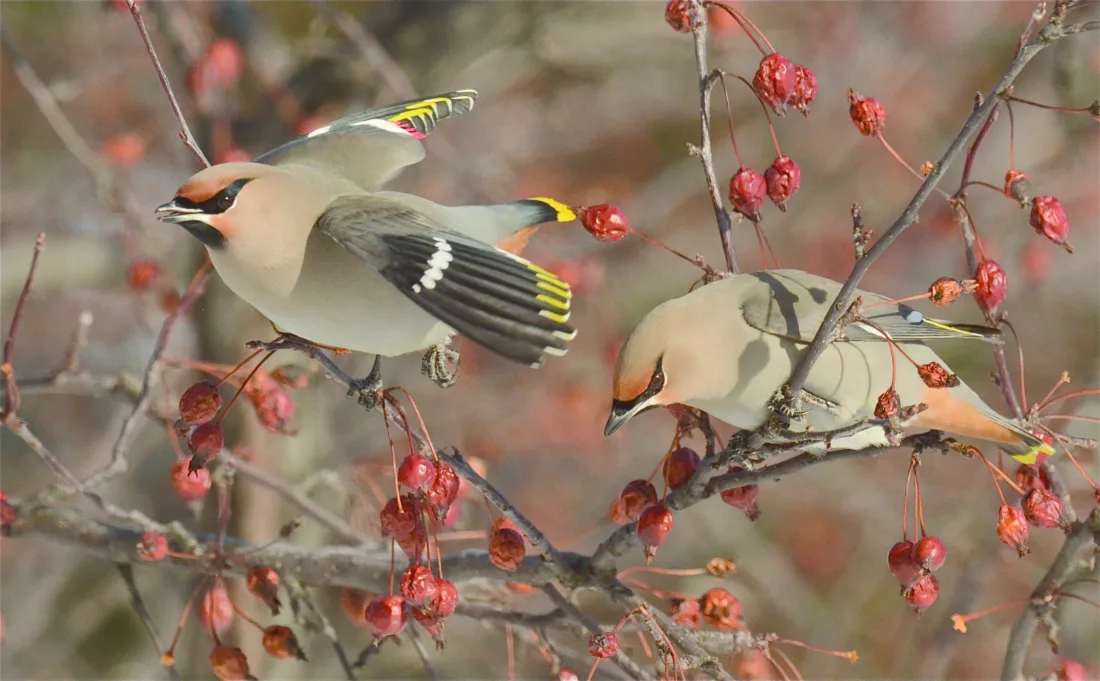
Bohemian waxwings are seen perching. (Scot Stewart photo)

STEWART
Bohemian waxwings are seen perching. (Scot Stewart photo)
STEWART
Trending
"Nearly all the best things that came to me in life have been unexpected, unplanned by me." - Carl Sandburg
Autumn in the Upper Peninsula probably has more surprises for some than any other season. The surprise snowstorm arriving during the peak for the fall color season. The big buck that turns up in the back yard one morning. The frost sparkling across the morning after the night that was "not supposed to get that cold". The wind that blew every last leaf off the most beautiful maple around. There are fall surprises around every corner.
The autumn birds have kept pace with the weather too. Bohemian waxwings had been close to the top of that list recently. During the wind tossed days last week a flock of eighteen was seen as they worked through several mountain ash trees in the teeth of high winds in Marquette. Over the weekend small bohemian flocks seen began changing to larger groups. South of the Tahquamenon River mouth in Chippewa County one of over 200 birds was seen on Monday there and another was found of 110 farther south on Wednesday.
Numbers began popping on Tuesday in Marquette too. Early in the day 300 were found at the Chocolay River in Harvey getting drinks on the river. The search was on then to see where others might be seen in the city. Some birders began scoping out the mountain ash and crab apple crops in the city in early fall to assess the potential to attract and retain some birds in town during the winter months and provide ideas of where to look.
A flock of more than 60 was found just east of Lincoln Street later that morning. It was in a single tree full of crab apples at a residence. As is typical for their foraging, they were resting in a large nearby tree and diving down to grab a few fruits, swallowed whole, before flying back up. Vehicle traffic flushed them. The mountain ash fruits are all but gone in town. Late flocks of robins cleaned out much of this year's fruit, though small amounts of it still remain, especially in trees away from busy roads. Crab apple trees have an incredibly varied look in Marquette. Some trees are literally devoid of fruit and other trees have just as smattering of fruit. But some trees, especially with smaller fruits are full.
After the flock was seen the second time, the search was on again to find where it went. Some of the places where waxwings are seen in the fall when they first appear in the Marquette area are the three crab apple trees at the entrance to Presque Isle Park, a group of trees on the southwest corner of the Vandament Arena on campus, and a large grove of crab apple trees on the east side of the Marquette County courthouse. The park trees were nearly bare and the trees at Vandament were completely empty. No birds at either. The courthouse trees are full of fruit, but there were no birds there either.
Marquette has literally hundreds of crab apple trees across town, from south Marquette to the streets straddling Lincoln north of the Park Cemetery so there are plenty of places to look. One of the quieter areas waxwings and other fruit foragers occasionally stop is a small group of crab apple trees on the west side of the Holy Cross cemetery. It is usually fairly quiet there, little traffic, the trees have smaller fruits, and there are a number of tall maple and oak trees nearby. It is a perfect spot.
That's where they were. Even better, there was a single pine grosbeak there with them. The waxwings were roosting high up in a number of trees, more than forty feet up, so it was difficult to count the flock. The birds were sweeping down a dozen at a time, swallowing two or three crab apples, then flying back up. They have an amazingly efficient digestive system said to move fruit from the branches to the roof of a car in fifteen minutes. They can extract proteins, fats, and carbos quickly, allowing them to survive almost entirely on fruits all winter. They stuck around for more than an hour and were even joined briefly by a pileated woodpecker, that hung onto a rosary station as it appeared to grab a couple apples too.
The Ontario Winter Finch Forecast for the winter predicted large crops of mountain ash in Ontario and western provinces would keep most waxwings and pine grosbeaks from wandering too far south this winter. While it is still early, so far, the number of the waxwings have only been moderate and pine grosbeaks miniscule. Birders in the U.P. hope the crab apples here will keep some birds around.
Early predictions of migrating red and white-winged crossbills this fall indicated there would be some good numbers of them in the Great Lake states and that has proven to be the case. Flocks of both have been seen in Marquette and a number of other U.P. locations.
At Whitefish Point, the fall waterfowl count concluded on Nov. 15. While the daily eight-hour count has concluded, birders have been continuing to post their sightings there and at many other across the U.P. on eBird. The strong south winds this week may have slowed the movements of ducks and lingering birds a bit, but migration has definitely not been as dramatic. Long-tailed ducks, scaup, hooded and red-breasted mergansers, buffleheads, and common goldeneyes can be found on many bodies of water like Teal Lake, Tourist Park, and around Ludington Park in Escanaba. A few tundra swans are also still moving through the area with fourteen seen south of Paradise this past Wednesday. Seesawing temperatures and winds will keep most everyone guessing in the next week or more for the unexpected.