
What’s Flying: A last salute to autumn’s end
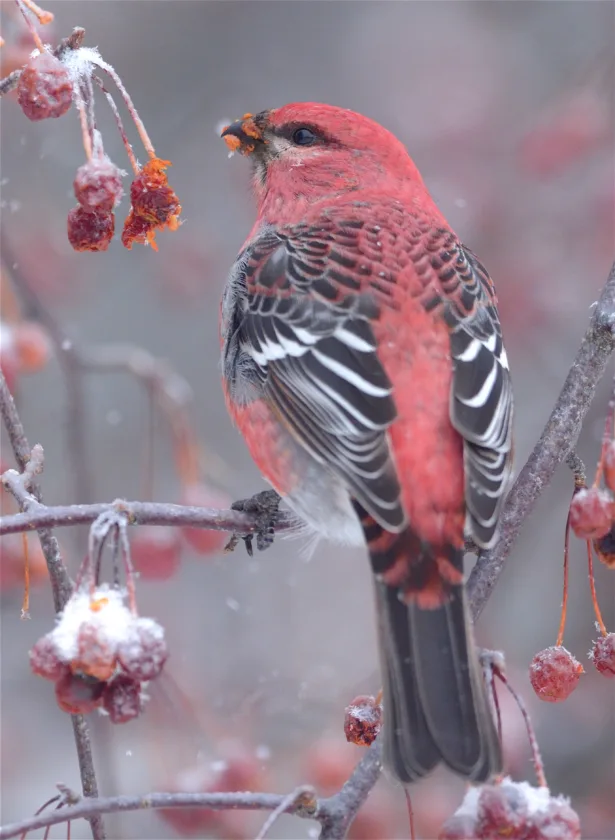
A male pine grosbeak looks on. (Scot Stewart photo)

STEWART
A male pine grosbeak looks on. (Scot Stewart photo)
STEWART
Trending
"The thinnest yellow light of November is more warming and exhilarating than any wine they tell of." – Henry David Thoreau
Most everyone living in the Upper Peninsula of Michigan or the Northeastern U.S. knows November can be a brutally dark month. Some years have seen streaks of three weeks straight with no signs of the sun. It is almost as if Ole Man Winter knows the bright drifts of the first permanent snows will come as a welcome change to the cloudy browns of mild November days. On those days when the sun has broken through, they seem like days for dancing in the street, just simply glorious days. Native Yoopers, and others with long runs here know those sunny days are true gifts and are not to be taken lightly. They are to be taken seriously for their light!
Just a couple days left for the fall waterbird counters working at Whitefish Point north of Paradise in Chippewa County. It has been another amazing season there this fall. This past week proved again the fall migration season is far from over for several species! The week had so many highlights for so many different bird species.
The biggest numbers were for long-tailed ducks. Last Saturday was a great day with 1014 counted. But Friday was a supreme day with 23,569 counted during the eight hour counting period. Because counters do not count before or continue after the official count period, it is not known just how many zoomed past on those days.
Winter finches also continue to move through in extraordinary numbers. Over 600 pine siskins, 569 red crossbills, and 1796 American goldfinches were added to the fall count over a five day stretch ending on Tuesday as many may be leaving areas where food is extremely low due to summer conditions. Most of these birds will continue heading southward, but some may remain in the U.P. and capitalize on the white and yellow birch catkins full of seeds.
Gulls appear to be on the move as well. During the fall and winter months gulls moving south from the Arctic often move American herring gulls and great black-backed gulls and join them for short periods. All four species were seen this past week at Whitefish. Eventually all these gull species may show up at some of the Lake Superior shoreline areas in Marquette and Munising, and some landfill areas like the Dafter landfill in Chippewa County.
As the leaves are all shed from mountain ash and crab apple trees in the U.P. birders begin to assess the fruit crops of all these species in anticipation of the possible appearances of bohemian waxwings and pine grosbeaks in their area during the gray winter months. Both species have bright, colorful plumages to brighten up otherwise colorless days. They will both be welcome visitors if they make it to the U.P. and simply delightful visitors if they stick around. Many of the area's crab apple trees had particularly great seasons of production this year and are full of fruits if the birds do arrive here.
Female pine grosbeaks can normally be difficult to find in crab apple trees. Their olive-green-brown plumage blends in unbelievably well with the branches of crab apple trees. Birders occasionally find a few females in a tree and are delighted to find them until a loud noise flushes them and they discover, there are not two or three birds, but a dozen that have been feeding in the tree. Males, on the other hand, are a gorgeous pink with white and black markings. They are usually seen in smaller numbers than the plainer females and juveniles in a flock.
Bohemian waxwings are also beginning to move into the area at Whitefish and could be conspirators at the crab apple trees with the pine grosbeaks. They have tannish bodies, with chestnut patches around their beaks, heads and tails. It is their wings though carrying all the brilliant colors. They have red and yellow tips that make them spectacularly colorful and fun to watch as they move through the crab apple trees. Waxwings usually prefer crab apples with smaller fruits they can swallow whole. Grosbeaks gravitate toward larger crab apple fruits they can bite into for the seeds inside.
Back to Whitefish Point and a number of unusual, rare sightings there have continued to brighten up the November counts. Among the smaller discoveries there this past few days were a purple sandpiper, a number of red-throated loons, and two Pacific loons. Eighty common loons were also seen. The purple sandpiper is one of the rarest here in the U.P.
Delta County has seen some interesting congregations of birds recently too. At the Rapin River boat landing last Saturday 19 swans were found. Most of them were trumpeter swans. These could have been local swans beginning to look for places to head as the winter get closer.
At the Mackinac Straits the annual stop-over of redhead ducks is also happening. The number of ducks there slowly built from about 1000 to an estimated 4000 on Tuesday. Traditionally, this point is an annual stop for ducks in the fall, and provides a real challenge to see as the flocks below the bridge challenge drivers to view as they cross the straits. Recent counts have come from Graham Point in St. Ignace.
The raptor count there has also been extremely productive at the Straits. Last Tuesday, red-shouldered, sharp-shinned, Cooper's, red-tailed, and rough-legged hawks, merlins, bald and golden eagles were seen crossing the over at the Great Lakes. The five golden eagles were definitely one of the highlights on the day.
With the recent rains, mushrooms and newly greened ferns have joined these late migrants in a wonderful last salute to autumn's end.