
What’s Flying: See, hear and smell the season
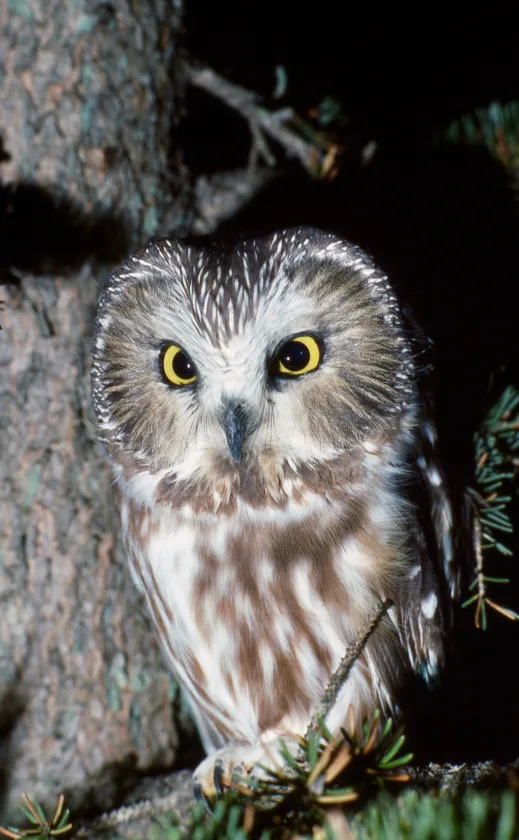
A northern saw-whet owl looks on. (Scot Stewart photo)

STEWART
A northern saw-whet owl looks on. (Scot Stewart photo)
STEWART
Trending
"One of the greatest joys known to man is to take a flight into ignorance in search of knowledge." - Robert Staughton Lynd
Spring and Autumn in the Upper Peninsula are uniquely precious times. While the periods of green and white extend considerably longer for summer and winter, the wedges of their sister seasons are much shorter and in their short time slots, seemingly filled with much more dramatic colors and exciting surprises.
Even this fall's maples have beamed with more crimsons and vermilions than almost anyone expected because of the exceptionally dry conditions and extended drought experienced by most all of the central and western parts of the U.P. this summer. The Dead River at Co. Rd. 510 was exceptionally amazing this month, punctuated with some terrific reds and oranges. A few lingering New England asters have added dashed of deep purple to liven things even more.
The current migration of birds has also supplied both suspected and unexpected surprises too for those venturing out into the fall woods. A black-backed woodpecker found over a week ago near the Wetmore Bog apparently has continued there and was seen again this past Tuesday. More of a boreal species, black-backs are rare in the Marquette area, preferring conifer stands like those along the Peshekee Grade along the Marquette-Baraga County border and areas where recent wildfires have killed pines and other larger conifers.
Unlike the work of hairy and pileated woodpeckers often excavating extensive holes in tree trunks to seek out carpenter ants and other insects, black-backs flake away at bark to expose cambium bark hosting borer beetles and other insects feeding on the bark of trees that have recently died. Flying bark is one of the best ways birders find these woodpeckers.
Last Friday saw some predicted gusty conditions in the Marquette area that provided some surprises too. When winds are high in the Lower Harbor, most songbirds usually steer clear of the breakwall. It may be the winds make escape from merlins and peregrine falcons more difficult to maneuver through, as small birds are a rare find there on windy days. A late walk in the day turned up two surprises out there though. Late fall finds a number of migrants, like American pipit, coming south from Hudson's Bay and points farther north. Usually after only short stops to rest and refuel here, they continue on to their winter range in the southern tier of states across the U.S. It was a bit surprising to see one on the breakwall in the wind foraging on both levels of the concrete.
A short time later a rusty blackbird also showed up on the breakwall. They provide a number of surprises. They often migrate in mixed flocks with red-winged blackbirds, common grackles, and even brown-headed cowbirds, so single birds are a little unusual. The other surprise it provided was being on the breakwall at all, and especially being in the strong winds was particularly unusual. Sleek iridescent black males resemble females in winter plumage, with the females having stronger light brown streaks over their eyes. This bird was a female. More interestingly though, they only go through one molt per year, as the lighter feather tips wear down, exposing the black iridescent feather in the males by springtime. They too summer north to Hudson's Bay, but in the boreal forests of Canada and Alaska, wintering in the southern two-thirds of the eastern U.S.
The blustery winds rushing over the breakwall brought even more birds to the grassy areas around the Coast Guard Station that night. As the sun set dark-eyed juncos, palm and yellow-rumped warblers, white-throated and Lincoln's sparrows, and even a hermit thrush arrived to forage in the grass and weeds before it got dark. The next morning, with clear skies and light winds they were gone.
Ducks have begun arriving in the Lower Harbor too. On Monday a flock of redheads, greater and lesser scaup, common goldeneyes, common and hooded mergansers were seen foraging in the shallows at Founders Landing. Some ring-necked ducks were observed at Tourist Park later in the week and a pair of trumpeter swans have also been hanging around in the county this week. They were seen on the Dead River late last week and a pair, possible the same two, were seen on Harlow Lake over the weekend. Trumpeter swans have appeared irregularly over the past five years or so on the Dead River, apparently learning there is plenty of food along the river from a number of bird feeders at home along the edge. This seems evident with their behavior -- often swimming down toward observers, apparently looking for handouts of corn or other foods.
Tuesday and Wednesday brought more migrants to the Lake Superior shoreline near Wright Street with the arrival of nearly one-hundred lapland longspurs and horned larks. They began arriving on Tuesday night and small numbers were seen on Wednesday morning. But by the afternoon the flock had grown to nearly one-hundred, feeding in the seeds from the new plantings along the new shoreline project. Extremely flighty, they moved frequently with the activity of joggers and walkers.
The most surprising birds to show up this week thought may have been in the Huron Mountain Club, a private community in the far north part of north Marquette County. Birders there had a trio of really great birds last Tuesday night. A pair of American woodcock were seen along one of the unpaved roads in the club to start. Later both northern saw-whet and a boreal owl were heard and confirmed with the Aves Vox app on their phone. Northern saw-whet owls are summer residents in the U.P. with more migrating through in the fall. Boreal owls, as their names suggest, spend most of their lives to the north, but in stressful years do head south in search of food. It is one of the best times of year to see, hear and smell the season!