
What’s Flying: The season opens its full palette

STEWART
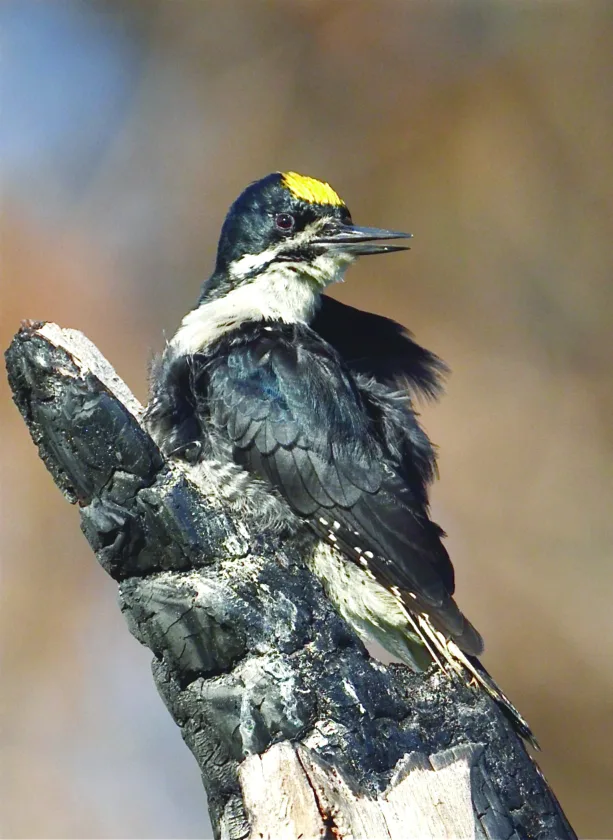
A black-backed woodpecker looks on. (Scot Stewart photo)
STEWART
A black-backed woodpecker looks on. (Scot Stewart photo)
Trending
“Delicious autumn! My very soul is wedded to it, and if I were a bird I would fly about the earth seeking the successive autumns.” - George Eliot
By all standards, autumn is officially here. The transition this week was softened by the summer-like weather on Tuesday leading up to the equinox Tuesday night.
As autumn winds along, bird migration will wind down. The two current wave of migrants streaming through the Upper Peninsula currently are the thrushes and the sparrows. Small numbers of hermit, Swainson's and gray-cheeked thrushes have been wandering through the area and those stopping are usually looking for insects, spiders, and other invertebrates, particularly on the ground, and berries like mountain ash, Virginia creeper, and buckthorn.
Evidence of a large push of sparrows was evident at Whitefish Point this week. White-throated sparrows led the way there as they in most places so far. Chipping and savannah sparrows have also shown up in some good-sized flocks. Swamp, vesper, song, Lincoln's sparrows and dark-eyed juncos have also started to show up. There have not been many white-crowned sparrows or big flocks of juncos yet though, so more sparrows are definitely yet to come. Horned larks, American pipits and Lapland longspurs will join them on the ground in larger numbers soon too.
Shorebirds are close to being completely through. The last rounds will include sanderlings, killdeers and a few plovers. A Baird's sandpiper was found at the mouth of the Dead River in Marquette on Tuesday. Flocks of sandhill cranes are beginning to form, and they will stage in some daytime fields before heading out in the next few weeks.
As autumn moves along and bird migration ends, many birders start to look for more adventures to extend their end -of-the-year birding. For some, especially those living close to the Great Lakes, a trip to the U.P. may be the answer to find a few new birds while enjoying some of the most beautiful areas in the Midwest. Some of the birds they come north to see are black-backed woodpeckers, Canada jays, boreal chickadees, and "winter" finches. Most of these birds have traditional year-round ranges in the U.P.
These areas are in pockets of "boreal" forest - mostly black spruce, balsam fir, mixed with tamarack and some aspen. Some of the best places include the eastern U.P. from Paradise to Tahquamenon Falls, the M-95 corridor between Koski Corners in Champion and Republic, and probably the best of all, the Peshekee Grade, Co. Rd. 601, along the Marquette-Baraga County line, from Champion to the Triple A Road west of Big Bay, that includes the edge of the McCormick Wilderness. These areas, by the way, are also some of the best places to look for moose in the U.P. as they often settle into wetlands in these boreal forests. eBird reports on the internet though the year keep birders informed on current populations and their locations.
The winter finches, red and white-winged crossbills, pine grosbeaks, pine siskins and redpolls also move through these same areas but only stay long enough to clean out the conifer seed cones before moving on. Crossbills are really unique though as there are extremely tied to these cone crops. If they find a particularly good crop of cones over a large area, they may settle down and nest there, regardless of the season or weather, sometimes nesting even in mid-winter. eBird, again, is one of the best places to see where others are seeing this group of birds, but it is possible to get a head start on planning a trip by checking the annual Winter Finch Forecast.
This is an Ontario ornithological report released each fall listing the food availability of conifer, birch, and mountain ash seed crops used by finches and other birds, like bohemian waxwings, red-breasted nuthatches, and blue jays. The report summarizes the conditions of these food crops and predicts the chances of movement of various species southward during the winter to find addition sites with favorable food supplies. Because of the proximity of the U.P. to Ontario it is a reliable source of information on the possibilities of seeing some of these species during the winter months.
Whitefish Point can also be a great place to see the finches during fall migration. This week has seen flocks of both pine siskins and red crossbills come in off Lake Superior across the point. In some years, hundreds and even thousands are counted flying past the point by the counters there.
Occasionally, conditions present opportunities for some of these birds to wander outside their normal ranges. One of the best at this is the black-backed woodpecker. It is a bird of fire, drawn to areas with recent wildfires. When fires kill and damage trees, especially red, white and jack pines, black-backs may move into the area. The smell of smoke attracts a variety of bark beetles, especially sawyer and metallic bark beetles, able to lay their eggs inside the outer bark after trees are unable to produce protective sap to fend off beetle attacks.
Those invasions then attract the woodpeckers knowing the beetles can in turn be harvested from the injured or dead trees. The birds can be found flaking that outer bark away to reach the beetle larvae inside. The woodpeckers also listen for the beetles in other dead trees. That was the case on Tuesday when a couple of visiting birders noticed bark falling from a red pine on a rocky outcrop near the Wetmore Pond north of Marquette. They were rewarded with a female black-back giving them excellent views of this unusual species. Other locations where fires occurred this summer are also good spots to look for black-backs this fall and winter.
Catch some of the last "summer" weather, some late fall migrants, and maybe a surprise or two under the fall colors as the season opens its full palette.