
What’s Flying: Much to be said for being an early bird
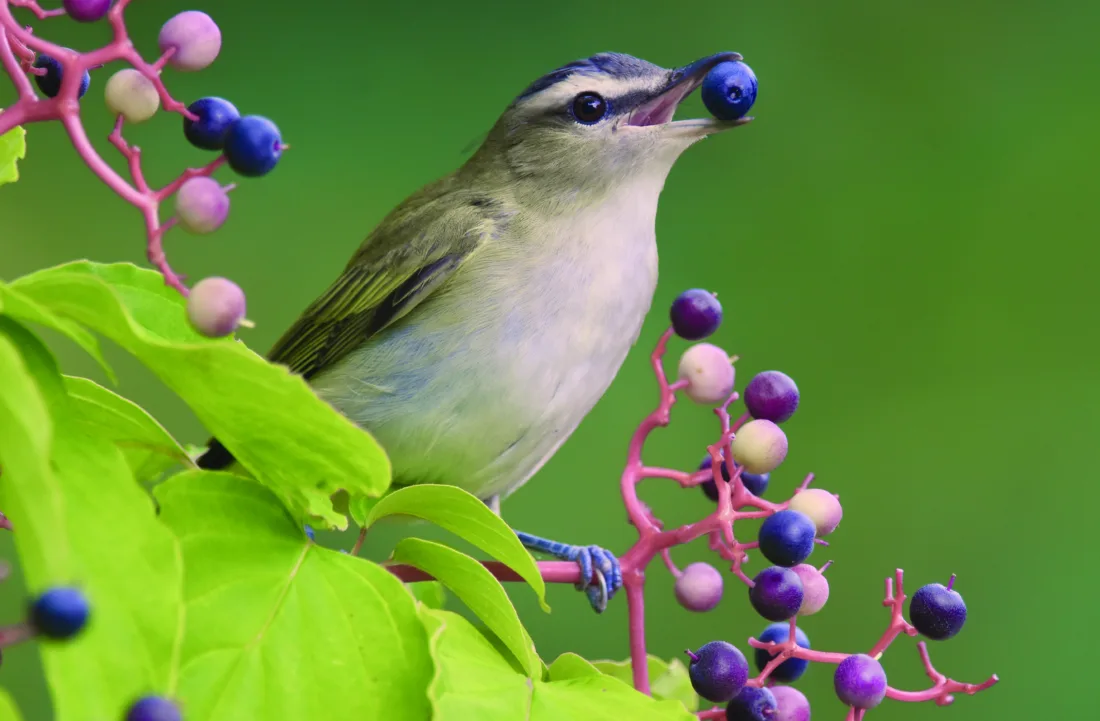
A red-eyed vireo has a bite to eat. (Scot Stewart photo)

STEWART
A red-eyed vireo has a bite to eat. (Scot Stewart photo)
STEWART
Trending
"At the end of the day, your feet should be dirty, your hair messy, and your eyes sparkling." - Shanti
Being outside in the Upper Peninsula can be just like an unwitting treasure hunt. August skies are filled with newly fledged birds, freshly emerging bright, perfect butterflies, bumble bees coasting over fields of bright yellow goldenrod, cone flower, and tansy flowers. The current stretch of dry conditions has definitely dried up muddy sections of woodland trails but also slowed the emergence of new mushrooms along the trails, except in moist, shady spots.
Hiking around Marquette, especially Presque Isle offer a good chance to spot or hear a peregrine falcon, or maybe even a pair of them. They have been active all summer in town although for past two years there has only been on nesting pair in town.
While two power plants in town maintained large smokestacks and nesting boxes, there was a pair nesting at each. With their decommissioning and removal falcons have turn entirely to natural structures to nest. A nesting box built on a roof in south Marquette was briefly used but has stood empty the past two years. Both peregrines and their small relatives, merlins, have been heard and seen around Marquette. Both species of falcons have been very vocal and often easy to find.
There are a few birds still singing out there - red-eye vireos have shortened their treetop songs but can still be heard atop some maple, birch, and aspen trees where they are foraging. Northern cardinals and mourning doves can frequently hear singing, although only briefly before returning to foraging. On the other hand, chatty blue jay and crow families can be heard throughout the day in residential areas and in places like Presque Isle Park in Marquette. Young blue jays can be distinguished by their grayer breast and head plumage.
It has been quieter in some residential areas recently as both common grackle and starling families have not been seen with the same frequency. Until just a week or two ago families were regulars foraging in yards and visiting local feeders.
Belted kingfishers have been seen at a large number of sites on the water across the U.P. this summer. Kingfishers are truly dramatic summer resident and really fun to watch as they sit on perches over open water waiting for a small fish to swim by. When that happens, they do a head-first plunge into the water to catch it. Unfortunately, they are extremely skittish birds and rarely stay on their perch when humans arrive nearby. Even their nesting is secretive, burrowing into the top of unreachable sandy bluffs. Nest tunnel slope upward and can be one to eight feet long.
Because females are out of sight when incubating eggs, they do not have to have cryptic-colored plumage. In fact, females are the more colorful of the two sexes. Both sexes are stocky, crested birds with blue-gray heads, backs, and collar bands. Females have a second, brick red lower band and flanks.
The Cornell All About Birds website for them includes an interesting paragraph regarding digestion in belted kingfishers. Young birds have highly acidic gastric secretions capable of digesting bones, gill plates, and scales of fish. After they leave the nest though, this chemistry changes and the birds regurgitate pellets containing these parts, similar to what owls do. These pellets can provide valuable information about what the birds are eating.
Kingfishers from the Upper Peninsula probably don't migrate far. Their winter range includes most of the lower 48 states, but the birds are limited to winter areas providing open water. With more climate changes their fall movements may become even shorter.
A campout on the Chocolay River may provide an opportunity to hear common nighthawks hunting overhead. These birds hunt insects at night and can call frequently making a raspy "beep" call. Males also can make a booming sound flying into a dive at night. As they rise backup at the end of a dive the air racing past the tips of their wings can make a loud whooshing or booming sound. Mid-August does begin the time when migrating common nighthawks can be seen heading south for the winter. Their summer range extends northward across most of the southern half of Canada as well as most of the lower 48 states and the highlands of northern Mexico. They will overwinter in most of South America except the western deserts, the Andes, and the extreme southern end of Chile and Argentina. As they start fall migration nighthawks often follow lake shorelines. As a result, locations along parts of Lakes Superior, Huron, and Michigan can offer the chance to see small streams of migrants in late afternoons and early evenings as they head south.
Walking the Lake Superior beach during mid-August at can yield a great diversity of shorebirds as the true early birds begin their southern trek. This past Tuesday a late morning on the beach there turned up a piping plover, a Baird's and two least sandpipers, and three sanderlings. In the air a pair of red-necked grebes, two northern harriers and three ruby-throated hummingbirds were seen. A pair of ruffed grouse, thirteen cedar waxwings, three pine siskins, four red crossbills and three species of warblers were also seen.
Over the next few weeks good numbers of shorebirds, often in small family groups, may be seen on lake beaches. Areas close to river mouths can be particularly productive and north facing shorelines, like those at the Dead River in Marquette, AuTrain River in Alger County, and Whitefish Point can be quite rewarding - as long as it is before larger numbers of beach goers arrive. There is much to be said for being an early bird!