
What’s Flying: Part of a beautiful summer
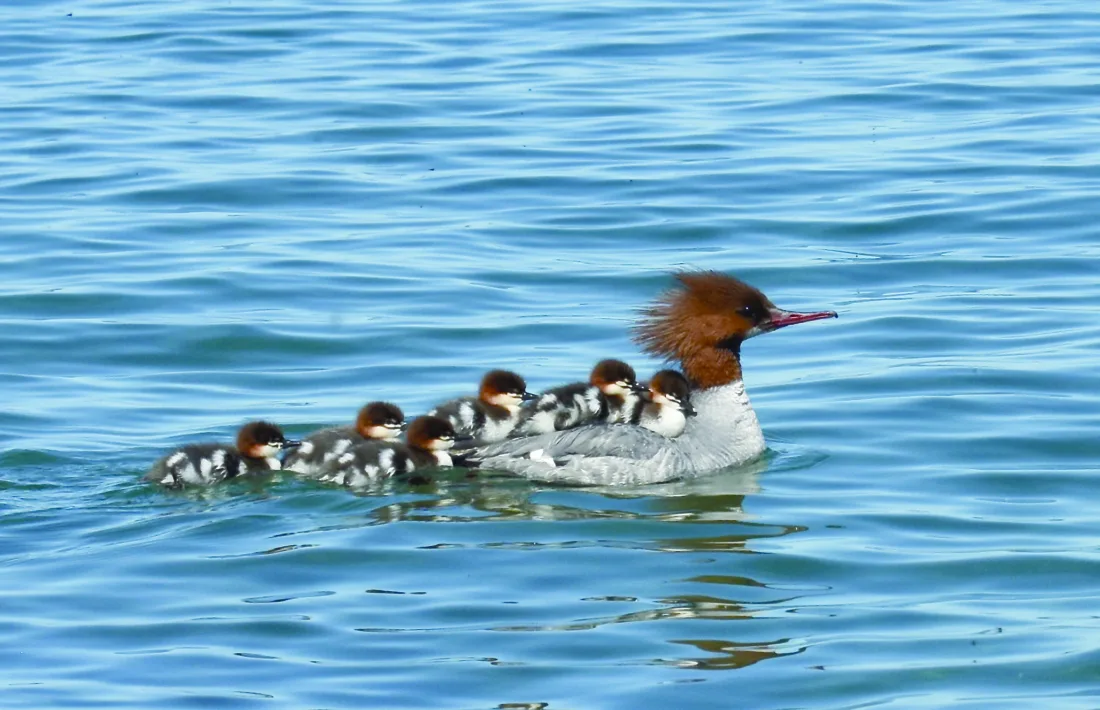
A family of common mergansers float on. (Scot Stewart photo)

STEWART
A family of common mergansers float on. (Scot Stewart photo)
STEWART
Trending
"I drifted into a summer nap under the hot shade of July, serenaded by a cicada lullaby, to drowsy-warm dreams of distant thunder." -- Terri Guillemets
July have been filled with hot shade, cicada choruses, distant thunder and so much more this summer. Temperatures soared to near 100F this past Tuesday across a variety of sites across the Upper Peninsula. Fortunately, a complimentary breeze eased into some locations, like Marquette, and cooled them a bit. Northern dog day cicadas, one and a half long insects commonly heard through treetops on warmer days along with several other less common cicada species a buzzing away overhead. Last Sunday's blasts of torrential rain were well punctuated with rolling rumbles of thunder too completing a symphony of true summer sounds. Unfortunately, much of the thunder was directly overhead and accompanied with 60+ mph wind gusts!
Some dangers to songbirds may or may not be weather related. Several young northern flickers may be without a parent as a result of a possible accident with a electrical power pole. A flicker was found at the base of a pole at McCarty Cove this week that may have had a tangle with a transformer. Birds occasionally get between energized parts of transformers (those cannister-like portions) at the top of poles and ground parts like wires, completing the circuit electrocuting the birds.
As young flickers leave the nest, they accompany adults to areas where ant colonies provide food for these woodpeckers. During late summer flickers can frequently be seen in yards and along curbs hammering away at ant nests. As they stir up the colonies, more ants rise to the openings providing more food for the birds. Adults show young where the colonies are found and how to make the most of foraging techniques.
There has been more to these days though than the bucolic days of summer. With the arrival of forest fire smoke in the northern Great Lakes everything seems to be up in the air. Mid-week forecasts showed little hope for relief until possibly after predicted Friday rains.
The smoke creates challenging conditions for wildlife as well as humans. Some of those most challenged are young nestlings and fledglings. Young, developing respiratory systems are always at risk. Studies looking at the effects of forest fire smoke have indicated profound effects can occur. Decreased visibility can impair foraging ability and can reduce the amount of food nestlings receive. Young birds unable to fly are totally trapped in places where conditions may totally unsuitable. Long-term conditions of poor air quality can leave birds disoriented to the point they abandon nests or incubate nest with no eggs. American goldfinches, cardinals, robins and mourning doves are still working on nest in towns, and many other songbirds are also tending nests with young outside of towns.
Many hope the recent rains will be enough to keep blueberries, blackberries, and raspberries growing with the sporadic heat that has been drying everything up between showers. The past few years have seen some areas struggle to produce much fruit. These and other fruits like serviceberries play an important role as mid-summer food sources for a variety of local songbirds like, gray catbirds, cedar waxwings, robins, hermit and Swainson's thrushes, and other fruit eaters. Cedar waxwings have appeared on many eBird recent checklists, but usually in small numbers -- two to four birds. Thirteen waxwings were seen at Whitefish Point during a two and a half hour visit there last Tuesday.
Great sightings are beginning to pick up again at Whitefish again. Two piping plovers continue at the point. An unusual black vulture was found at the point on Tuesday too. Turkey vultures have become much more common in the U.P. Adults are easy to identify if their reddish heads are visible. In flight, their V-shaped wing shape and their tendency to rock back and forth as they soar helps differentiate them from soaring bald eagles. Young turkey vultures have black heads.
Black vultures are smaller than turkey vultures and have a year-round range across the southern half of the eastern U.S. and parts of Texas and Arizona. They have shorter and wider wings than their larger cousins. They have poorer sense of smell than turkey vultures and often watch for them to find food. Black vultures do occasionally wander as far north as the U.P. but are rare.
A sanderling was also found on the pebbly beaches at the point this week indicating the beginning of the southbound travel season may have begun for shorebirds. A Monday eBird report from Grand Marais provided additional support for this. Besides resident killdeer and piping plovers found there, two species of migrant sandpipers, A Baird's and a semipalmated sandpiper were also seen on the beaches in town. Daily checks are made at the mouth of the Au Train River in Alger County. The river mouth is a great place to see shorebirds there during both spring and fall migrations, however none have been seen there recently. A number of sandhill cranes sights have been seen.
One of the more surprising sets of sightings has been of a number of young families of common mergansers. Several females with young ducklings have been seen in Alger County, including one with nine youngsters. A female with nine ducklings was also found on the edge of the Lower Harbor breakwall last week. Several have had young small enough some young were still riding in the mother's back. In some families from previous years, young that small in Marquette were found the first week in June, a month earlier. They are just another part of a beautiful summer.