What’s Flying: Spring is moving in loving ways

STEWART
“We will always choose Earth. We will always choose each other.” – Christina Koch, Mission Specialist crew member Artemis II
Even though the challenges of getting spring truly started continue the Upper Peninsula still looks like one of the best places ever, for both Yoopers and birds alike. One look at the current events like flooding, tornadoes, wildfires, and mudslides, and those late snow showers and light ice storms don’t seem quite so bad. For migrants, there have to be some surprises as they proceed northward. Currently, there is no snow on the ground south of the Appleton area where some parking lot piles are still evident. North of Green Bay there is still some accumulation in shaded areas. Uniform cover starts north of Menominee, but serious snow depths don’t start until migrants get into north Delta County.
Despite the apparent delays reaching those spring conditions the early migrant species continue to arrive, although at perhaps a somewhat slower rate than normal. With each warmer, sunny day though there is a new set of arrivals from the south to brighten up the still wintry landscape. That land was just recently populated by the first eastern chipmunks to appear, mostly around bird feeders where there are some steady supplies of food. The hope of course is they will find enough to sustain them until conditions improve.
A western meadowlark lark continues to find some food around the mouth of the Dead River in Marquette where it was first seen last week. Occasionally meadowlarks and other grasslands birds somehow find their way to the open areas around the entrance to Presque Isle Park where another western meadowlark was seen in 2023. Years ago, the area next to the Bog Walk trailhead was an open field with few shrubs and more grasses and goldenrod stems. Meadowlarks and even a few bobolinks turned up there during a number of past spring migrations. Meadowlarks have also been seen in Big Bay and at Whitefish Point this spring.
Eastern and western meadowlarks can be difficult to tell apart, especially from a distance. Both occur in the U.P. during the summer but have differently shaped bills and tails. Cornell’s All About Birds website reports Meriwether Lewis, from the Lewis and Clark Expedition, was the first to describe the difference between the two species. Western meadowlarks are slightly lighter with beaks that are more slender and have yellow “moustaches.” Eastern meadowlarks’ bills are heavier and they have white moustaches.
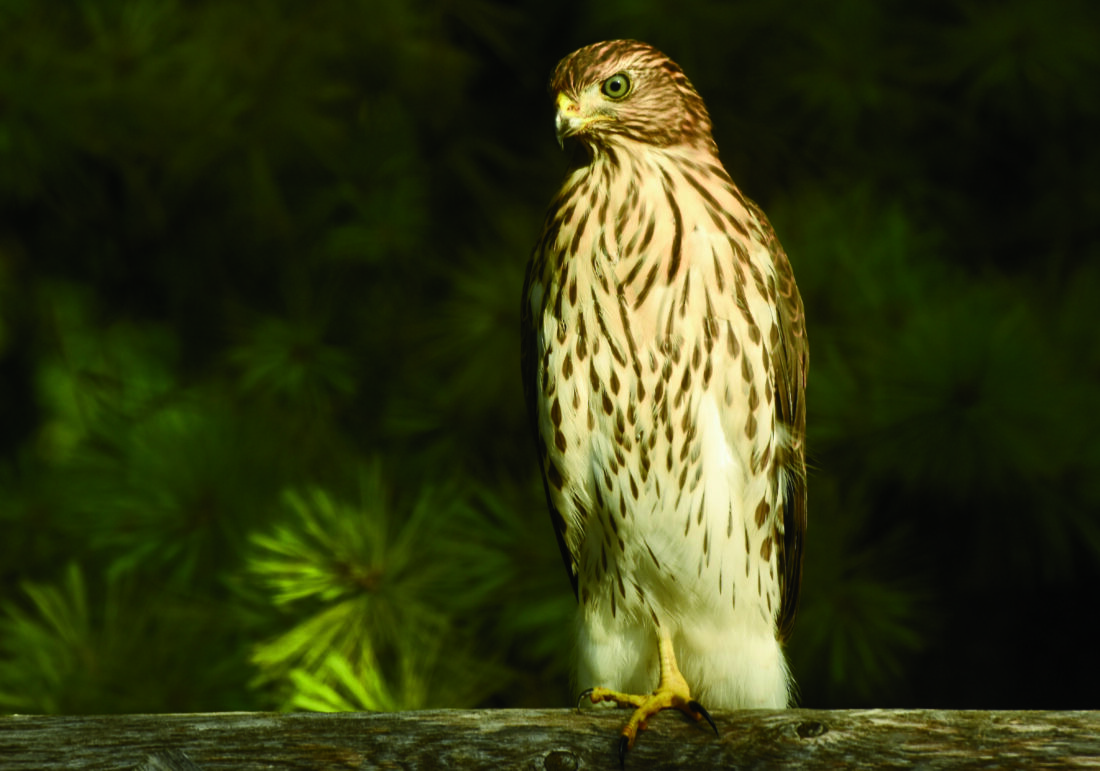
A Cooper's hawk looks on. (Scot Stewart photo)
The All About Birds pages also describe meadowlark’s habit of gaping. In order to create holes in the soil to reach insects and other foods deeper in the soil, they can stick their bills into the soil and using extremely strong muscles open their bills to make the holes. This can be a huge benefit to the birds as they complete with other ground feeders searching for food this early in the season.
Dark-eyed juncos are also showing up at feeder stations and some other areas where there is bare ground and weed seeds are still present. Juncos are one of the most common and numerous birds on the continent and have highly variable plumage forms. In the southwestern states and Mexico there is a second species, the yellow-eyed junco.
Great birding continues most days at Whitefish Point due to its location as a point of land jutting into Lake Superior and because of the raptor counters, sponsored by Michigan Audubon, there for at for at least six hours every day. These experienced, veteran counters there provide terrific monitoring of daily migrants at the point.
Other recent highlights at Whitefish Point have included steady numbers of bald and golden eagles, some of the earliest raptors seen there each spring. 30 bald eagles were seen on Tuesday. Significant numbers of passing winter residents include a few pine grosbeaks and more than one-hundred white-winged crossbills this week and newer migrants like sandhill cranes. Red-tailed hawk numbers have also picked up as all three accipiter hawks are being seen that include sharp-shinned hawks. Cooper’s hawks, and northern goshawks. Red-shouldered hawks are also starting to fly through.
Several sharp-tailed grouse have been seen regularly at the point this spring too. They are permanent residents in the eastern U.P. and are most often seen farther south in east of Paradise as they are grassland species. An American woodcock was also seen this week at Whitefish Point. A true ground feeder, it will need to find open wet soil, probably near a wetland edge to find invertebrates in the muck and mud. Snow buntings are trickling through on their way back from the northern half of the U.S. to the High Arctic of Canada and parts of Alaska. Their breeding plumage of black and white is a sharp contrast from their winter tans and browns.
Snow buntings and turkey vultures have also been working through the Marquette area too. Fourteen turkey vultures were seen north of town last Tuesday. Like bald eagles, they will rely heavily on road-kills, especially deer, for food in the Lower 48 right now. A northern flicker was also seen in Marquette this week. Small flocks of redpolls have also been seen foraging on Presque Isle, bouncing from the bare ground to the cover of trees as potential signs of danger appeared.
In Marquette’s Lower Harbor waterfowl diversity is beginning to pick up too, with red-heads, ring-necked ducks, and canvasbacks, all divers showing up there. Things continue to be quite interesting on Lake Superior, as icebergs, ice pancakes, and ice cover are literally changing by the hour as winds changes direction and velocity.
And on the great horned owls nest box in Hancock maintained by the Copper Country Bird Club, young owlets are halfway to brown fledgling feathers and about 2/3 the size of their mother.
-

- STEWART
-
- A Cooper’s hawk looks on. (Scot Stewart photo)
Friday: Outdoors

Outdoors North: Rain catches up with me
What’s Flying: Spring is moving in loving ways
DNR weekly fishing report
Little Bay de Noc: Anglers reported slow fishing for yellow perch, and any fish they did mark were lethargic, ...
DNR’s U.P. fishing report

People and animals alike, ready for spring to arrive