
What’s Flying: New bird arrivals give hope to the coming of spring
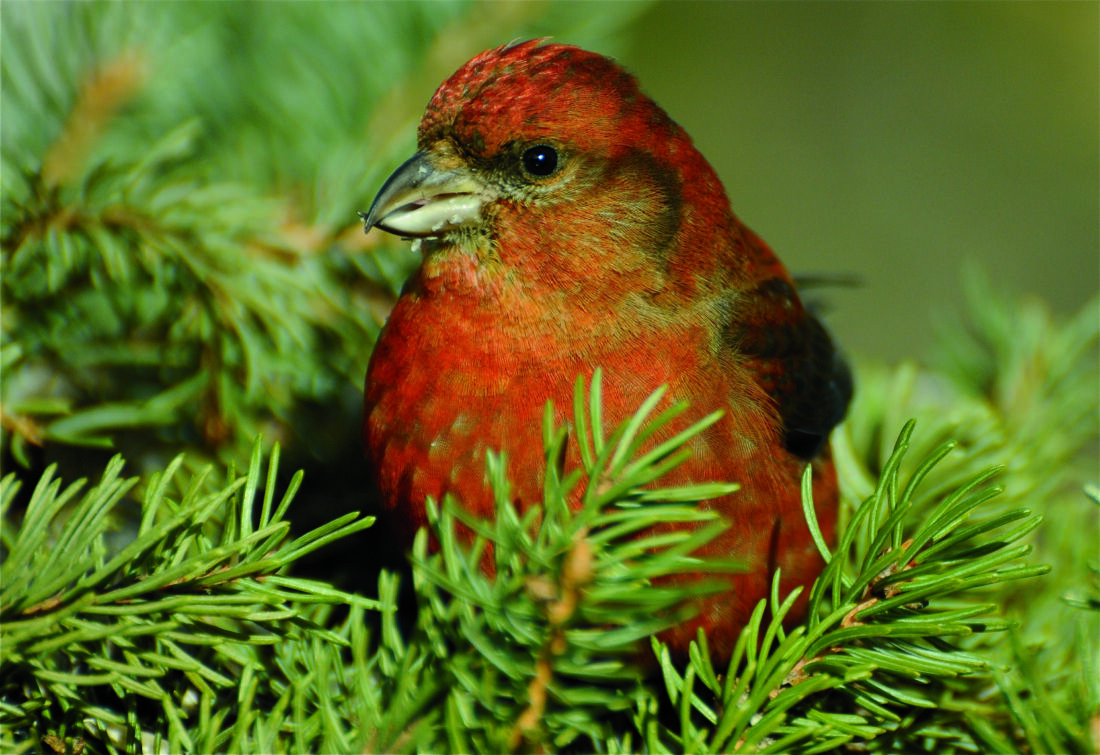
A red crossbill looks on. (Scot Stewart photo)
“Despite the forecast, live like it’s spring.” – Lilly Pulitzer
Despite the impressive amounts of snow recently, a small number of bare patches are appearing on some of the university’s athletic fields off Lakeshore Blvd. in Marquette. The early arrival Canada geese found their way to them this past week, with over 40 seen feeding there. Birders have kept track of their numbers as migration continues but have also looked through the growing flock for signs of other goose species. Cackling geese, a smaller goose with the same markings as Canada geese, greater white-fronted, Ross’s and snow geese are other species occasionally stopping in the area during spring migration.
Duck numbers in Marquette have also vacillated recently, particularly for the diving ducks. Long-tailed ducks had gone from a pair to a dozen last Tuesday in the Lower Harbor of Marquette. Common and hooded mergansers have jumped up and down all winter with the amount of open water at the Dead and Chocolay Rivers and Lake Superior. The Chocolay has also hosts several other ducks, dabblers, that may have been in the area all winter. A northern pintail, and recently a pair of green-winged teal were recently seen there with around 100 mallards, some American black ducks and five Canada geese.
Open areas near K.I. Sawyer have also appealed to migrants. Horned larks have continued in some open areas just west of the airport. With the short weeds, some with last fall’s seeds that have suited the quintet of early migrants. A few horned larks pass through the U.P. during migration, but most stay farther west.
Other early migrants have also popped up, either for the first time or again following some of the recent foul weather. Both common grackles and red-winged blackbirds have continued to wander into the northern counties. Last Tuesday a turkey vulture was spotted in Escanaba along the Escanaba River north of town. It is a bit early for them to be heading this far east, with their bare heads exposed to the colder temperatures, ice and snow.

STEWART
Most turkey vultures are returning after wintering in Central and South America. There is a fair amount of food along the highways, especially as deer feed along open patches of dried grass just off the shoulders. The catch for that food cannot be frozen. Vultures have weak beaks and feet and are unable to strip frozen flesh from carcasses. They can turn to landfills to feed on other easier to eat morsels.
Vultures also have several strategies to deal with the colder temperatures. At night they can go into a mild torpor, becoming slightly hypothermic, dropping their temperature up to 6 degrees farenheit to save energy. In the morning they can assume their traditional pose with wings extended and facing the sun to warm. This position is called the horaltic pose. The main problem with it is that on these spring days, just thinking about spring is not enough to warm up when it is cloudy or snowing. Most vultures will probably keep to the south until temperatures warm a bit more.
Gull watching continues to be superb in Marquette, at both the Lower Harbor and at Picnic Rocks. With the ever changing ice coverage the vast bulk of American herring gulls moves around after the majority of them return from feeding at the Marquette County Landfill. Most all the ring-billed gulls back in the city for the summer are seen at Picnic Rocks. A number of glaucous gulls currently in town have been seen at Picnic Rocks too. Iceland gulls have been spotted at both locations this past week.
The Keweenaw continues to be a great spot to see pine grosbeaks, pine siskins, and redpolls. Pine grosbeaks do continue to be appearing at multiple sites in the U.P., including Marquette. There are still many locations in town where crab apple trees are still holding onto good amounts of fruit, and with the continuing winter conditions it may be an appealing spot to continue here.
Chippewa County has also seen good numbers of winter finches, At Whitefish Point on Monday, redpolls, pine grosbeaks (113), and both red and white-winged crossbills (27) were all seen. A pair of golden eagles and 13 bald eagles were also tallied. Sunday was actually a better eagle day. During the day there 20 golden eagles, 19 bald eagles and a red-tailed hawk were all counted!
It’s probably a bit early for U.P. residents to begin thinking about ruby-throated hummingbirds and their progress migrating northward, but it does provide the hope and expectations of spring’s emergence. Data collected by Hummingbird Central www.hummingbirdcentral.com/hummingbird-migration-spring-2026-map.htm maps sightings of hummingbirds across the country and provides a great window on their progress north.
-
- A red crossbill looks on. (Scot Stewart photo)
-

- STEWART
As spring continues many get the reassurance of it progress with the sighting of the first robin of the season. For many in Marquette there will definitely be confusion due to the hardy flock that survived the entire winter here. They have continued to find most of their needs filled with the area’s crab apple fruits. They have also been able to reap the benefits of the extra eyes occasionally provided by a flock of European starling often seen feeding in the same trees. Once in a while they have also been joined by the lingering Townsend’s solitaire continuing in the area this past week. Despite the forecasts, the melting snow, sap rising up the maple trees and the new bird arrivals give hope to the coming of spring.
Friday: Outdoors
What’s Flying: New bird arrivals give hope to the coming of spring

Outdoors North: My own version of “Four Thirty-Three”
DNR weekly fishing report
Little Bay de Noc: Anglers reported slow fishing when targeting perch and attributed the slow fishing to the cold ...
U.P. fishing report

Outdoors North
DNR weekly fishing report
Little Bay de Noc: Shoreline ice started to deteriorate, forcing anglers to pay attention to the ice conditions ...