
What’s Flying: An exciting time for birding

STEWART
“If you think you are leading and turn around to see no one following, then you are just taking a walk.” – Benjamin Hooks
It was a great warm-up! Lots of sunshine, temperatures in the 40’s, and an ever shrinking pile of snow! Residents in the Upper Peninsula know events like that are often short-lived. There were surprisingly sizeable numbers and varieties of others possibly misled though by the winter thaw who committed to a bigger move in response to the apparent signs of spring.
Canada geese were the most noticeable arrivals across the U.P. with groups up to half a dozen in north Marquette, on the Chocolay River and at numerous other sites. They joined mallards, American black ducks, common goldeneyes and a group of trumpeter swans on the Dead River near the mouth. Red-winged blackbirds have also made a significant arrival, with five seen on the Dead River Marshes and other sightings in town and along the Wisconsin border. There was a common grackle also in the mix in with the blackbirds. Near Felch, 30 red-wings were seen on Tuesday. Red-winged blackbirds continued at the latter location on into Wednesday, but the numbers reported were lower.
Elsewhere in Dickinson County an eastern bluebird and an eastern meadowlark were reported last Sunday. The bluebirds are a bit hardier than the meadowlarks, but neither are in their best frames with lots of snow, especially the latter, a ground feeder. Similarly, a trio of horned larks seen near K.I. Sawyer may also be challenged by the returning wintery conditions, as they too are ground feeders. The bluebird and meadowlark may continue on and establish territories in the U.P., but the horned larks will probably move on. Although their year-round range includes nearly all the Lower 48 in winter, they do move out of the southeast as spring begins and for the most part, they do not nest in the U.P. northern Wisconsin or northern Minnesota.
Raptor migration is also underway. North of Marquette more than 20 bald eagles were counted as they headed northward west of Lake Superior. In Chippewa County, a northern harrier and a golden eagle were seen, the harrier near Rudyard and the eagle near the area where rough-kegged hawks and northern shrikes continue.
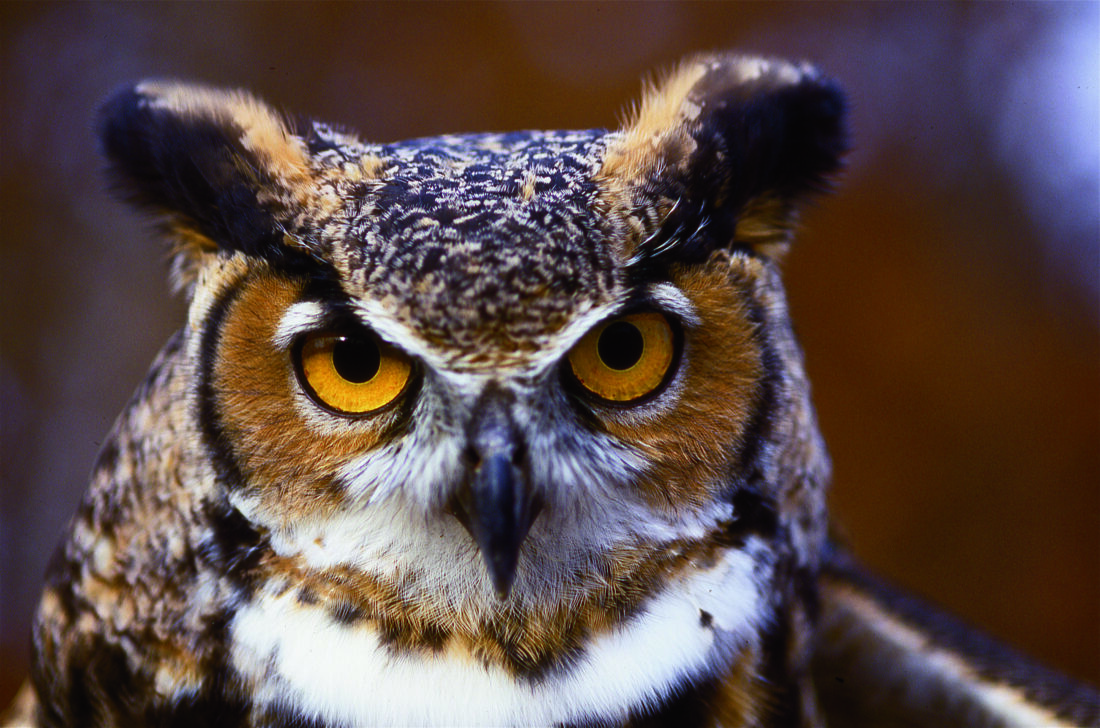
A great horned owl looks on. (Scot Stewart photo)
Some winter guests have continued in the U.P. Last Thursday a snowy owl did show up in Marquette last Thursday. It was an early evening stop high atop a building near the U.S. 41 bypass. Snowy owl sightings jumped in Chippewa County where five were found on the fields near Rudyard last week. Last Sunday a flock of 200 bohemian waxwings was seen south of the Soo. Pine grosbeaks have also continued in Chippewa County, and in small numbers at other sites across the area.
Snow buntings have continued to turn up at numerous places in the eastern U.P. Several were seen in the Marquette area too, but they may be ones that overwintered farther south and are now headed northward. Snow buntings summer across the far north, primarily across the tundra across Scandinavia, Russia, Canada, and Alaska.
Another winter guest continuing on the east side of Marquette has been a Townsend’s solitaire. It may be the guest with the longest stay in town this winter. It has wandered around town looking for fruit – mountain ash, winterberry, crab apples and juniper cones. It has benefited from the vast supply in town, as has a flock of robins. This has been special winter for a robin flock that remained in the city this season, numbering as high as a dozen. The current flock is smaller, though it is not known if the flock just split or has lost some members. Most recently they have been seen in the same area as the solitaire, at a nursery sold crab apple, possibly a hybrid of the Eurasian crab apple. The fruits are small and very hard and only a few have fallen so far. European starlings have also been seen feeding on the fruits this week.
There are some birds with little regard to weather or the calendar – great horned owls. Great horns are probably the most common of all the owls in U.P. towns. In Hancock one nest, at the Jutila Center, has been monitored by a great webcam, https://www.youtube/live/-0Gc1ygtYfc. The site is about 11 blocks west of the lift bridge near the Portage Canal. Copper Country Bird Club has another nest box with a webcam at the Quincy mine and a peregrine webcam, not yet occupied, all found at https://coppercountrybirds.org/webcams
The view of the nest is spectacular, the colors of the female rich and beautiful. Currently she is huddling over two white fuzzballs of recently hatched owlets. The camera was down for a while and it’s difficult to find information about when the owlets hatched, but with an incubation time of a month, the females have been in the nest boxes at work since early February! The Jutila nest box has been crammed with fresh rabbits. On Wednesday afternoon, the Jutila female turned and spend some time feeding on one of the rabbits. In the typical behavior for them, the female opened her wings to partially cloak her prey. The young were shielded behind her so there were just a few parts of the young’s’ feathering visible.
It is going to be a while before events ramps up again for the next
-

- STEWART
-
- A great horned owl looks on. (Scot Stewart photo)
Friday: Outdoors
DNR weekly fishing report
Little Bay de Noc: Shoreline ice started to deteriorate, forcing anglers to pay attention to the ice conditions ...

Outdoors North: The only constant is change
What’s Flying: An exciting time for birding
Nobody said vegetable gardens must be in the backyard; put them out front if it’s sunny
DNR weekly fishing report
Little Bay de Noc: Anglers reported fair fishing this week. There were reports of walleye in areas from Gladstone ...