
Outdoors North: The only constant is change

JOHN PEPIN
“I seen you walkin’ every day on your way to school, I seen you talkin’ to the children I seen you talkin’ too, ooh yeah – school teacher,” – Bob Seger
The street was wet and the air was cold.
It wasn’t wintertime, but it was dreary.
I was just a kid, maybe 7 or 8 years old, walking to school along the most direct route I knew — but that didn’t mean I was in a hurry.
Dawdling was part of being a kid.
I filled my time soaking up the environment around me. I had a full eight blocks to explore between our front door and the old red-stone grammar school.
The first three blocks were the least exciting, likely because this section of our tree-lined residential street was the closest to our house, and therefore the most familiar to me, but that doesn’t mean there was nothing to note.
Everything seemed interesting. Most things were much bigger and taller than I was. I spent a lot of time walking slowly, looking up, down and all around — which are some of the chief characteristics of dawdling.
The yards in front of several of the homes were big and grassy with the residences set back on the properties. Some of the homes had large, enclosed porches or stone walkways and stairways or all three.
Us kids often would remember neighbors as nice, crabby or crazy depending on their reactions to seeing us shortcut through their yard or walk along their wall or how they welcomed trick-or-treaters on Halloween.
The trees were mainly mature maples, though there was one yard on the corner of the second block that had a yew tree right along the sidewalk — easy to experience close-up.
That tree, which had dark green needles like a spruce or a balsam fir, had these cool, pink-red-orange berry-like fruits, which are called arils. They were about the size of the nail on my pinky finger.
I never tried to eat them, but they are supposedly sweet. The rest of the tree is poisonous. Even at this age, I had already been taught not to taste berries without asking whether they were “poison.”
At the second street intersection, there was a big mansion-type house on one corner — like the house the Munsters lived in — that could have been very creepy if the people who lived there didn’t have kids.
On the opposite corner, there was a funeral home.
Continuing onward, there was a library that became a familiar place to me, largely for its kids’ puppet shows on Saturday afternoons and its downstairs children’s library with books on everything from Vikings and the Egyptians to Curious George, the Cat in the Hat and Nancy Drew.
Then came Main Street, which was the dividing line between the known world and the new frontier.
The street started at the city playgrounds and went up one side and down the other of Strawberry Hill before forming the primary vein leading into the heart of the downtown.
It was on the first block inside this unknown territory where I stood on this chilly day.
Here, the entire south side of the street was taken up by a big hotel that was built on the grounds of two previous hotels that had burned.
The Georgian Revival structure had a huge front lawn bordered by decorative, waist-high ornamental shrubs with thorns and bright red berries.
I was standing at the backside of the building where a guest entrance and a linear parking lot bordered a sidewalk. I walked along this sidewalk to and from school.
The hotel had four stories. In this back section of the structure, guest windows faced the street and there were flower beds along the sidewalk with blooming marigolds and other flowers during the summertime.
Sometimes, when I walked along, I could hear guests talking through their open windows or a television set or radio. In those days, older people never talked much to kids. They just went about their business.
The saying, “children should be seen and not heard” was a real thing in those days, and I’m not certain we were supposed to be seen either. You weren’t supposed to get in the way of adults or bother them – especially if they knew your parents.
On this day, I was listening to starlings perched along the rain gutter. They were making a wide variety of calls, which included some mimic phrases learned from other birds. These black birds, with their long yellowish bills, were cool.
There was a big, brick chimney at the back of the building whose mere presence was impressive. The chimney often had smoke coming out of it, especially on cold days like this day.
At the end of the sidewalk there was a tall staircase with concrete steps and steel, rounded railings painted black. From the top of the stairs, if I leaned over, I could see through tall, partially steamy windows that the cooks were in the hotel kitchen making breakfast.
At this location, I could probably hear the school bell in the clock tower of the school ringing if I was about to be late, but I couldn’t say for sure. I decided to step up my pace a bit. Just in case.
I passed a church whose pastor’s house stood across the street from a house with a rock wall and a massive oak tree that dropped acorns all over the sidewalk and street.
We used to collect the fallen green and brown acorns in coffee cans. They were cool to look at and pull the caps off — good for shooting from a slingshot too.
At this place, I turned the corner and could see the school, three blocks away.
To get there, I passed the foot doctor’s office and several regular-looking homes, including another creepy house that was situated on one of the corners.
In the wintertime, we used to slide down the slippery sidewalk here on our feet. There would be 30-40 kids out there sliding, making a bunch of noise early in the morning.
From here, I would run the last block as if seeing the school, perched on its raised and walled foundation would snap me back into an understanding of what I was supposed to be doing and where I was supposed to be.
Orange wooden barricades blocked off the cross street next to the school where us kids were able to gather in the mornings and at lunch. Up the concrete steps and through the west side door and I was there.
I took off my “wraps,” hung them in the closet and got to my seat for another day of learning, socializing and moving between the bells from one place to the next.
On the walk home, with the prospect of playing outside awaiting me, the dawdling was often absent, unless I got distracted by something cool that I found along the way, like firemen, cops or construction workers doing their jobs.
There were alternate routes that became well established.
These short-cut “passageways” included hiking along leaf-covered alleys, cutting across vacant lots or jumping down from walls to walk narrow openings between adjacent buildings.
Sometimes, I would encounter dangers along the walks to or from school like bullying classmates, Main Street vehicle traffic or big snarling dogs running loose that somehow got off their chains or ropes.
Looking back on all of this, I realize that I am quite fortunate to have had those experiences.
Not only to become more familiar with the neighborhood I was growing up in, but to gain important qualities like self-realization and reliance, a sharpened sense of wonder, discovery and exploration, confidence and rain or shine the understanding that you go outside.
Today, the neighborhood is still there, but it’s changed.
It’s aged greatly.
It looks a lot smaller.
The yew tree is still there. After operating for about 50 years, the hotel is no longer operating as such. The pastor’s house has been torn down. So has the grammar school itself, after it was turned into an apartment house it burned when I was in high school.
The big oak tree remains towering over the sidewalk and the street, still producing acorns. It’s likely most, if not all, of the passageways remain intact.
Many of the homes have deteriorated and been sold.
Taxes have gone up. The standard of living has been weakened.
Most of the neighbors I would have known from those old days are no longer there, but a few are.
The house I grew up in was sold about 20 years ago, flipped and sold again.
The way the house looks today doesn’t much resemble the way it looked when I lived there. Of course, some of the general features of that old 126-year-old mining town house remain.
I wonder whether I’ve changed as much as the house or the street or the town or those old days.
It’s probably a wash.
Outdoors North is a weekly column produced by the Michigan Department of Natural Resources on a wide range of topics important to those who enjoy and appreciate Michigan’s world-class natural resources of the Upper Peninsula.
Friday: Outdoors
DNR weekly fishing report
Little Bay de Noc: Shoreline ice started to deteriorate, forcing anglers to pay attention to the ice conditions ...

Outdoors North: The only constant is change

What’s Flying: An exciting time for birding
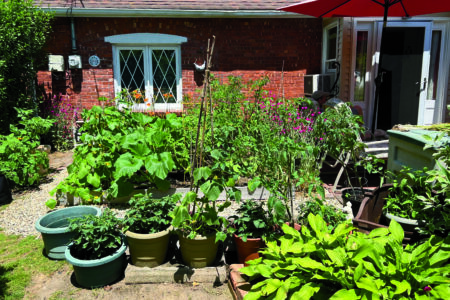
Nobody said vegetable gardens must be in the backyard; put them out front if it’s sunny
DNR weekly fishing report
Little Bay de Noc: Anglers reported fair fishing this week. There were reports of walleye in areas from Gladstone ...