
What’s Flying: Catching up with those flying friends
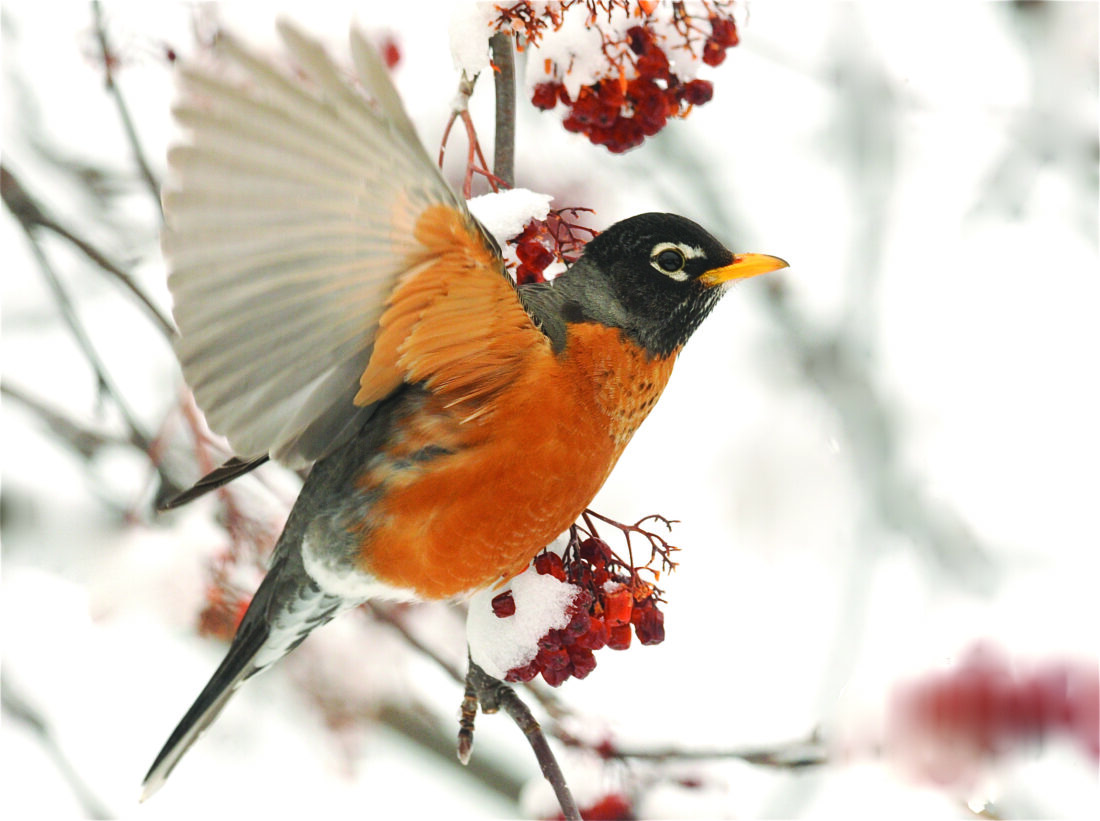
A male American robin looks on. (Scot Stewart photo)
 “In the bleak midwinter Frosty wind made moan, Earth stood hard as iron, Water like a stone; Snow had fallen, Snow on snow, Snow on snow, in the bleak midwinter, Long ago.” — Christina Rossetti
“A good friend is a connection to life — a tie to the past, a road to the future, the key to sanity in a totally insane world,” — Lois Wyse
This winter has definitely added some repetitious patterns, as it heads closer to its possible (?) mid-way point, with streaks of cold, blizzards, and plenty of snow. The company of friends has been one of the best remedies to deal with some of these patterns, especially on the darker days of the season, or at least on the days filled with the added attention needed to slippery roads, roof raking, and heavy snow shoveling, Groundhog Day only told everyone what they already knew — probably six more weeks of winter.
Fortunately, there have been loads of ‘friends” that have stuck around despite all the weather and the changes it has brought. Normally with the recent milder winters there have been some herring gulls (now officially American herring gulls to differentiate them from similar gulls in other parts of the world now considered separate species) remaining in some parts of the Upper Peninsula where there is some open water and a food supply, even if it is at an open landfill.
With much of the current ice cover over many of Lake Superior harbors, many gulls are moving southward in search of more favorable sites. The harbors have been most unpredictable with ice not safe for people. There are a few though hanging around South Beach in Marquette. None have been reported at Munising’s landfill, but at Dafter landfill in Chippewa County, 200 were counted on Tuesday. An estimated 100 winter resident ravens were also seen there. Possibly the same number of ravens were seen in Munising too. Looks like some have headed downstate. An eBird report Tuesday reported 2500 at the wastewater treatment plant in Muskegon.
It is always a welcome site to find a duck other than a mallard on the open waters of the U.P. in February. This is especially true this winter in light of the Christmas Bird Count results this past for Marquette as 2,284 were counted, probably with some overlaps by counters double counting some. With the harbors in Marquette and Munising iced over, most all the long-tailed ducks lingering in the U.P. this fall have now left, as the Big Lake waters have closed off. Most long-tailed ducks overwinter along both the Atlantic and Pacific Coasts, usually above the Lower 48. One was found on an open stretch of the Dead River this past Monday though.
Another lingering duck, a green-winged teal has continued in the open waters of Marquette with mallards. It was found again in north Marquette in the creek running parallel to Presque Isle Ave., near Hawley Street. Unlike the long-tailed duck, it is a dabbler, preferring shallower water to feed. With most of the lower end of the Dead River now frozen over mallards, American black ducks and other dabblers have all looked for other stretches of open water to feed.
The changes to ice cover on the Dead River also brings changes where other waterfowl is being seen. A quartet, probably a family of two adult and two young trumpeter swans, continue to be spotted on the Dead River in Negaunee Township. This is one of the longest stretches swans have continued during the winter on the river. As the weather begins to warm later this winter, either from thaws, or the start of spring, it will be interesting to see how long the swans stay on the river, and whether the open water will attract other species prior to the start of spring migration.
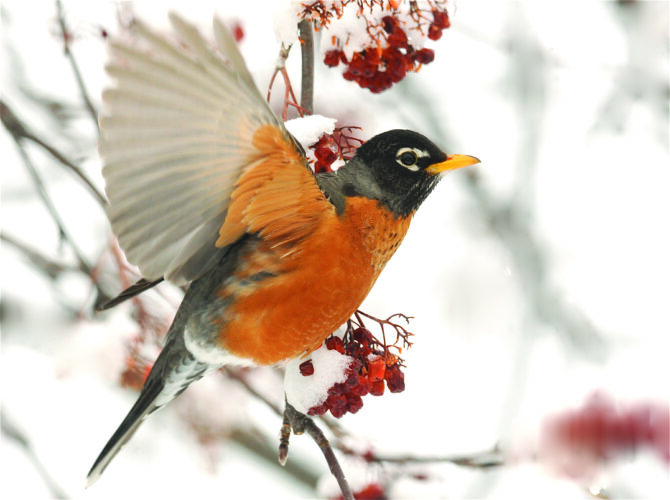
Robins! They have continued to hang in both Marquette and Escanaba continuing to rely on crab apples and other fruits to survive the cold conditions, A changing flock of from six to ten continued to wander around Marquette, occasionally joined by some returning bohemian waxwings, again in the area. A flock of as many as 76 waxwings has wandered around seeking the remaining crab apples in town. Because they prefer to swallow much of their food whole, they look for tinier crab apple fruits. Smaller flocks have been seen in Harvey too. A single robin was seen in Escanaba this week too.
A Townsend’s solitaire continues to turn up at a variety of sites near and around the Marquette lighthouse. The western vagrant has made its friendly visits around the east and south sides of Marquette since last December. Unlike the robins and waxwings, the solitaire’s diet is much more varied. It has been observed eating winterberry, Japanese yew, mountain ash, and crab apple fruits. Solitaires also feed on the fleshy cones of juniper when they mature and turn dark blue or black. Juniper cones are a heavily used food in their “normal” range out west around the Rocky Mountains and beyond. Those cones take three years to mature changing from green, to pale blue, to the darker shade, so birders looking for possible sites to watch for the solitaires can check the cones around town with the hope of eventually finding birds there. Waxwings occasionally feed on these cones too,
One last species of birds still continuing its stay in the Marquette area is a northern shrike. One has continued on the east side of Marquette often being seen around the Lakeshore Blvd. roundabout, the city compost area, and the edge of the field north of the old compost site. It’s a great time to catch up with the friends!
Friday: Outdoors
What’s Flying: New bird arrivals give hope to the coming of spring

Outdoors North: My own version of “Four Thirty-Three”
DNR weekly fishing report
Little Bay de Noc: Anglers reported slow fishing when targeting perch and attributed the slow fishing to the cold ...
U.P. fishing report

Outdoors North
DNR weekly fishing report
Little Bay de Noc: Shoreline ice started to deteriorate, forcing anglers to pay attention to the ice conditions ...