
What’s Flying: Precious sunset filled afternoons ahead
Trending
"Peering from some high window, at the gold of November sunset and feeling that if day has to become night this a beautiful way." – E.E. Cummings
Sunday morning will see Daylight Savings Time come to an end for another year in the Upper Peninsula. That morning sunrise will be at 7:33 a.m. Sunday morning and set at 5:32 p.m. For those finishing work late in the afternoon, it cuts the evening daylight after work down an hour so that morning sun becomes something to truly special to enjoy while it lasts! The sunsets will still be great if one can catch them.
The goldfinches are here. During the past few days American goldfinches have appeared for the first time in several weeks at area feeders in Marquette. Some supporting evidence can frequently come from the Whitefish Point waterbird counter in the fall about current bird movements and it did this past week for them Saturday through Monday, when 122 were counted at the Point reflecting the influx of them, presumably from Canada.
Interestingly, American goldfinches' (there are two more goldfinch species in the American Southwest - Lawrence's and Lesser) summer as far north as Canada's boreal forests and migrate back south into the Lower 48 states across the continent except for the Canadian Maritimes. Some may stick around in the Upper Peninsula all winter, especially close to sunflower and thistle feeders and many continue a little farther south across most of the Lower 48.
Several other species of songbirds and ducks also had big weeks. Last week it was noted long-tail ducks were also coming through the area in big numbers. They started showing up at Whitefish Point on October 1 and had moderately low numbers, mostly in single digits through the first three weeks of the month with the exception of October 19 when 130 were tallied by the waterbird counter. Then on the 21st the numbers busted loose. Last week's account here noted around 1000 had been counted on at mid-day last Wednesday. It turned out to be the biggest day so far for them at the Point with 5998 counted during the eight-hour census period that day. During the six day stretch when movements were truly notable, nearly 13,000 were counted at Whitefish Point. Since then, around 50 have been seen there each day all heading southward.
They winter around the Great Lakes and the northern Atlantic where open water is available, feeding on mollusks, crustaceans, and some plants, mostly on the lake and ocean bottom, diving as deep as 200 feet. What is notable about their diving is they do not use the feet to propel themselves, but rather by partly flapping their wings. As many as 21 have been observed in Marquette's Lower Harbor recently, diving underwater for as much as 45 seconds at a time in the deeper areas between Founder's Landing and the Lower Harbor breakwall.
Scoter and scaup species, and red-breasted mergansers have also been prominent at Whitefish Point and have shown up in the Lower Harbor in Marquette recently too. Frequently there is a small flock of redheads, greater and lesser scaup out in front of Founder's Landing. At times there a trio of hooded mergansers has been seen close to the old Shiras Steam Plant dock too. A pair of hooded mergansers was often seen in the same area last year too.
Between the piers south of the Lower Harbor ore dock has been a great spot to see red-breasted mergansers and horned grebes, especially on days when Lower Harbor waters have been rougher due to east winds. For those able to spend some time on the piers there, ducks and grebes frequently move in and out, sometimes foraging close to the piers offering great looks and a chance to watch them dive, and come up with a variety of foods they find.
It was noted early this fall more shoreline work was being done at the mouth of the Dead River. Fortunately, that work appears to now be done with no new changes to the beach at the mouth. While shorebird migration appears to be all but over it will be interesting to see what the area looks like next spring for migration then. There are some changes to the sand deposits along the beaches already this fall in Marquette, possibly due to those alterations to the shore between Hawley Street and the Pine Street-Lakeshore Blvd. intersection.
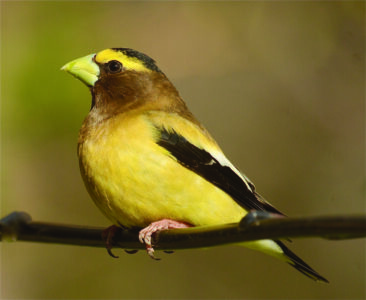
Winter finches are also beginning to appear in larger numbers too. Pine grosbeaks have shown up on several days at Whitefish Point and a pair was seen at Presque Isle this past week. Pine siskins are also wandering in, showing up on birders' eBird lists across the area. The same has been true for evening grosbeaks too with small numbers being seen across the area. Flocks of redpolls have been picking up at Whitefish Point with numbers there around 40 several days and single digit counts coming at other locations.
This past week a flurry of snow bunting sightings also began popping up. The latest at Whitefish Point noted 63 has shown up by late afternoon there. The buntings should be able to take advantage of the lack of snow cover currently to find weed seeds to fill up on as they forage. They will also be seen on roadsides and other open areas picking up grit to grind up those seeds in their gizzards. They often go unnoticed until they flush showing off their white breasts and wing patches. Weedy fields are good places to look for them. Enjoy those precious sunset filled afternoons!

STEWART
A male evening grosbeak looks on. (Scot Stewart photo)