
Beautiful weather pairs well with bountiful watching

Scot Stewart
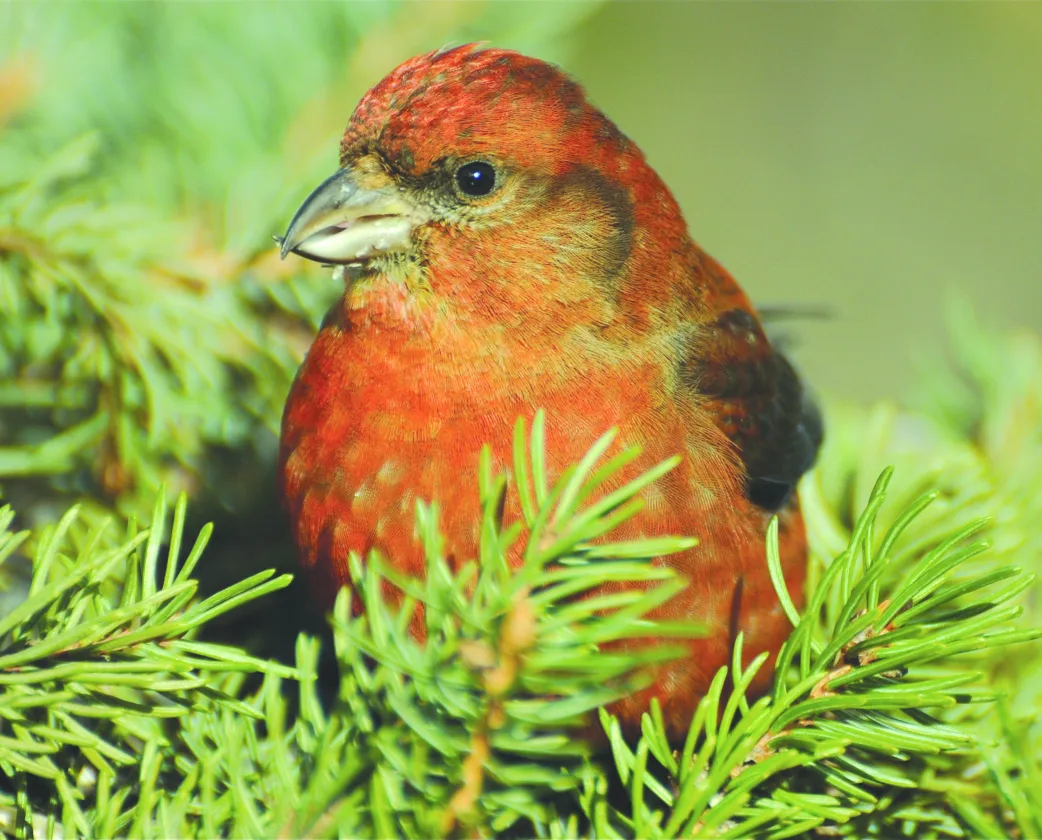
A red crossbill male like this one was among the bird species seen recently on the Peshekee Grade that straddles the line between Baraga and Marquette counties. (Photo courtesy Scot Stewart)
Scot Stewart
A red crossbill male like this one was among the bird species seen recently on the Peshekee Grade that straddles the line between Baraga and Marquette counties. (Photo courtesy Scot Stewart)
Trending
"I could never in a hundred summers get tired of this." -- Susan Branch
With the absence of wildfire smoke and excessively hot temperatures, it has turned into a remarkably wonderful stretch of summer in the Upper Peninsula.
The current weather has been an absolute delight for many, although a few strong storms have continued to pop up, creating some damage and a few power outages.
Marquette's park patrol has been kept busy lately with issues related to young birds and some weather conditions at Presque Isle recently.
During a recent storm, a common merganser mother with seven very young ducklings was pushed into the rocks along the edge of the park on Lake Superior. Caught swimming in a notch in the sandstone, they bounced up and down in the waves, unable to fight their way out due to the waves.
Gulls spotted their dilemma and were quick to take advantage of the situation, plucking up the very young birds one at a time for a quick meal. Five young ducks were taken before the park patrol could intercede and rescue the two surviving young. They were eventually relocated with a female common merganser along the lake shoreline.
An even more involved situation occurred with a young peregrine falcon in the park. It may have started when a young one slipped off some steep rocks, fell into Lake Superior and washed to shore nearby. Soon after that, a young one, possibly the same one, began showing up very close to human visitors. Sometimes it landed on picnic tables, occasionally on car rooftops, often making a noisy fuss. Finally responding to a call about it, park patrol approached the young falcon and found it simply remained in place.
The young raptor was gently picked up without a fuss and placed in the patrol car backseat. Rehabilitators in Houghton were contacted, and the bird was driven there for examination. Though slightly dehydrated, no injuries or apparent illnesses were detected, but it was thought it might have had some type of neurological issues. The young peregrine will remain in the care of rehabilitators and will become part of an education program.
As summer continues into August, attention will be directed to the southern U.P. along the north shore of Lake Michigan. Monarch butterflies will begin their long trek to the Mexican highlands for the winter, following the lake. Many will drop down the Stonington Peninsula in Delta County to make the short hop over the lake to Washington Island and Door County, Wisconsin. With a south wind, on a sunny day it is good hop. If the butterflies reach Peninsula Point on Stonington on a day with a strong south wind, they may layover until the wind direction changes. Occasionally, more than a thousand butterflies may wait in the white cedar trees on the Stonington for those winds to change, creating an amazing spectacle.
Birding can also be good at Peninsula Point. Last Sunday afternoon an early greater yellowlegs, 20 barn swallows, and a half dozen American white pelicans were seen there. But all were upstaged by spectacle of at least a thousand double-crested cormorants flying around the point over Lake Michigan.
Cormorants create a large amount of controversy on lakes Huron and Michigan as their populations increase. Because they can eat a pound of fish a day and are well adapted for diving, they can efficiently make a considerable impact on fish populations. Since yellow perch are a favorite food, they are truly disliked by the area's fishermen. When they nest in large colonies, their highly acidic droppings can kill all the vegetation on their rookeries, too.
Programs to reduce their numbers have successfully led to oiling eggs during the nesting season in some years. It cuts off the oxygen to the embryos, but keeps the birds on the nests without adding more eggs. This prevents successful reproduction at a site. In 2006, a hunter boated 30 raccoons over to Goose Island in Lake Huron, where 1,800 pairs of cormorants nested. By leaving chicken eggs there when the cormorants were not nesting to feed them, the raccoons were able to eliminate the colony in two years.
Cormorants are relatively new summer nesters in the Great Lakes, with the first colony established in 1913. At the peak of the pesticide DDT's impact on fish-eating birds in 1972, cormorants were listed as threatened species. They have rebounded since and are again the subject of conversations regarding control measures.
In other notes from birders, most have been relatively quiet and unremarkable. Recent visits by birders on the Peshekee Grade along the Baraga-Marquette counties' line found none of the boreal specialties that summer visitors are usually seeking, except one. Birds missed included boreal chickadees, black-backed woodpeckers, white-winged crossbills and Canada jays. Last Saturday, a pair of red crossbills, a pine siskin and a purple finch were seen, along with a winter wren and seven species of warblers.
Shorebird activity has also been slow so far this summer. Besides the aforementioned greater yellowlegs, only a dozen semipalmated sandpipers have been included in eBird notes recently. The 12 were seen with a spotted sandpiper at the mouth of the Dead River, also last Saturday.
The time of these was remarkable because of the increased use of the beach there this summer by swimmers. The time of the sighting, just after noon, may have been due to the cooler, misty conditions that day. Regular checks of the beaches at the mouth of the Au Train River in Alger County and at Whitefish Point in Chippewa County have been relatively quiet so far.
But there is still five weeks of "summer" left to get out and enjoy. It's the season that never grows tired.