
Even with most migrations over, significant sightings can be made
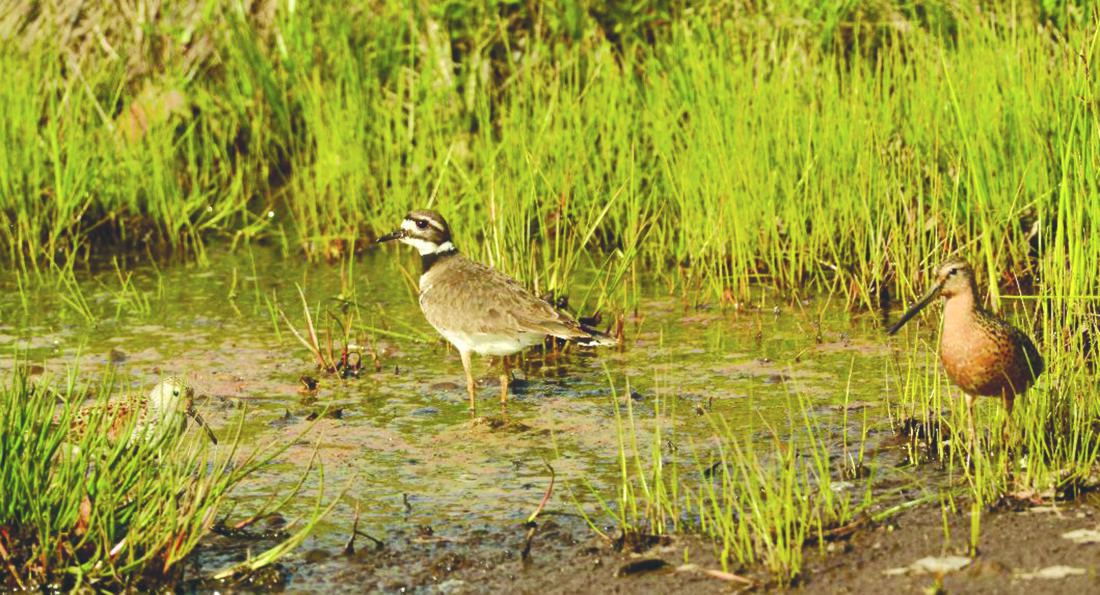
A dunlin, killdeer and short-billed dowitcher all seen together was a truly special event to be witnessed in north Marquette near Lakeshore Boulevard last week. (Photo courtesy Scot Stewart)

Scot Stewart
A dunlin, killdeer and short-billed dowitcher all seen together was a truly special event to be witnessed in north Marquette near Lakeshore Boulevard last week. (Photo courtesy Scot Stewart)
Scot Stewart
Trending
"May is the month of promise and the sweet beginnings of summer." -- Unknown
Some of the promises of May are still being delivered, but a quick look around finds green leaves on trees, hummingbirds, baby bunnies, packed beach parking lots and other clear signs that summer is at hand.
Lake Superior has still shown some stubborn resistance to letting go of cooler conditions, but if the current Canadian high pressure system finally gets pushed off to the east this weekend, it may be possible to even assure garden tomatoes and basal summer can finally ease in.
While a good share of bird migration has now passed, there are still interesting events filling spring with plenty of surprises.
Blue jays have provided a seemingly unending parade of large flocks. The woods in the center of Presque Isle in Marquette were filled with them on Monday and a large flock flew over the Dead River mouth Wednesday morning after a flock of 400 was seen over the Bog Walk.
At Whitefish Point, nearly 600 were seen Wednesday, but 1,573 passed through Tuesday. On Monday, 1,250 were counted. Not sure where they all came from or where they are all going.
Marquette has seen a few unusual species pop up recently, too.
On Monday, a rare piping plover showed up on the Lake Superior shore near Lambros Park and wandered past a number of swimmers. A few of these petite shorebirds will nest on the beaches in the eastern Upper Peninsula between Grand Marais and Whitefish Point, but they are rarities elsewhere, even during migration when they are passing through.
Except for some on the East Coast up into Newfoundland and some in the Canadian prairie provinces, northern Michigan is the northern edge of their range in the Midwest. They are related to killdeers and have a similar shape but are much smaller and paler in color.
Killdeers have been seen with regularity along Lakeshore Boulevard in Marquette. One last week shared the water's edge with two notable visitors and another summer resident.
Last Thursday, an adult great blue heron was found foraging in the mitigation pond off Lakeshore Boulevard near Wright Street. Birders slowing to get a closer look were surprised to see a killdeer on a small mud flat nearby.
A closer look revealed even more activity, though. A rare-to-the-area short-billed dowitcher was seen wandering through sedges along the edge feeding in the soft mud. Next, a dunlin, another shorebird, emerged and all three smaller birds ended up side by side. A mallard drake was also present there.
Dunlins are more frequently seen on Marquette's Lower Harbor breakwall feeding on midges, and the dowitchers are much rarer and usually seen on larger ponds. Seeing all three together was a truly special event.
Also seen on Wednesday, a least bittern flushed at the Bog Walk. This is an extremely rare wader for northern Michigan. And actually they don't even wade that much, often climbing from cattails and other vegetation instead of wandering through the water. Extremely secretive, helped by their cryptic brown colors and small 11- to 14-inch size, they are rarely seen under normal circumstances. The Portage Point Marsh near Escanaba is the best place to see them in the central U.P., and they are only rarely reported farther north.
A northern mockingbird sighting came from the Dead River this week, too. Spring is always the best time to look for them in the U.P. and this year has been no exception. Sounding like a brown thrasher or gray catbird, their calls usually become more versatile as they continue, filled with lots of phrases from other songbirds' melodies. Gray, black and white, they are notable when in flight as large white wing patches really stand out.
In other notes, Canada geese seem to be doing extremely well this spring. Recently at the Dead River mouth, three families were seen, with 10, 12 and 18 young geese seen with parents.
With the late spring and often cooler temperatures, this month has been a great time to get out on many of the U.P.'s great trails to bird, look for wildflowers, listen to frogs and toads, and get some exercise.
Whitefish Point in Chippewa County and Peninsula Point and Portage Point in Delta County all offer trails to hike where birding offers some of the best in the Midwest, especially during spring migration season. The Songbird Trail along Harlow Creek north of Marquette offers birding and gorgeous scenery all the way to Lake Superior at Little Presque Isle.
Several trails in the city limits of Marquette offer a quiet step away from crowds and great opportunities for wildlife, wildflowers and relaxing quiet time. The Carp River offers great scenery from the end of the Cliff Power Road west of the Mount Marquette turnoff, and along the canyon east of recreation complex off M-553.
Remaining in Marquette, the Board of Light and Power trails off Wright Street offer places where the hiking edges along the backwaters of the Dead River and small wetlands and through denser woods.
The Harlow Farms trails starting off the Iron Ore Heritage Trail just west of the U.S. 41 bypass railroad bridge in town is another site for birding, scenic woodlands and tranquil surroundings including a number of wetlands that are filled with great birding diversity.
Birders using the trail recently saw and heard over 30 bird species, including great blue herons and broad-winged hawks, with only one other person around. The Bog Walk trail is of course one of the best in town for birding and looks to get some upgrades this summer.
It is a great time for green hills and blue skies.