
Birds emerge as slowly as the snow melts

Scot Stewart
“Magic birds were dancing in the mystic marsh. The grass swayed with them, and the shallow waters, and the earth fluttered under them. The earth was dancing with the cranes, and the low sun, and the wind and sky.” — Marjorie Kinnan Rawlings
-
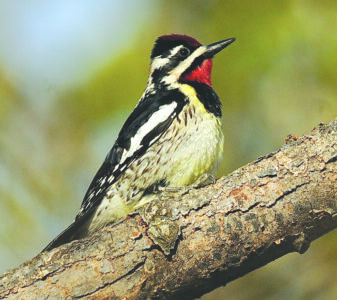
- This is a yellow-bellied sapsucker on a local tree limb. (Photo courtesy Scot Stewart)
-
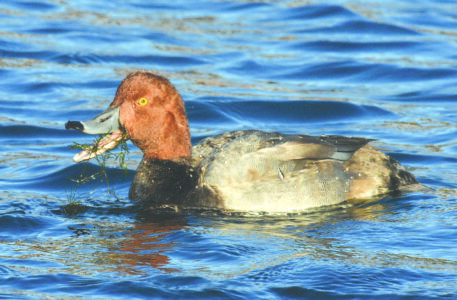
- This is a redhead duck feeding in area waters. (Photo courtesy Scot Stewart)
-
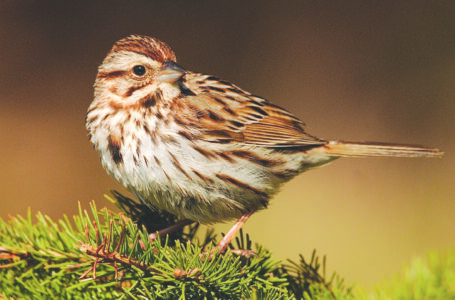
- This song sparrow finds a perch in a local fir tree. (Photo courtesy Scot Stewart)
-

- Scot Stewart
It is difficult seeing a pair of sandhill cranes standing on snow drifts and ice-covered wetlands, or ducks rafting up on the Great Lakes under snow showers.
Hopes across the Upper Peninsula are for conditions to improve soon for wildlife this spring. While there has not been a big wave of any new species sweeping into the U.P., there have been some new arrivals seen in our neck of the woods.
Perhaps the most obvious latest arrivals are more Canada geese. In Marquette alone, there are probably close to a hundred, with pairs dotting most of the open waters. Close to 50 have been seen regularly grazing on the fields next to the Superior Dome in north Marquette.
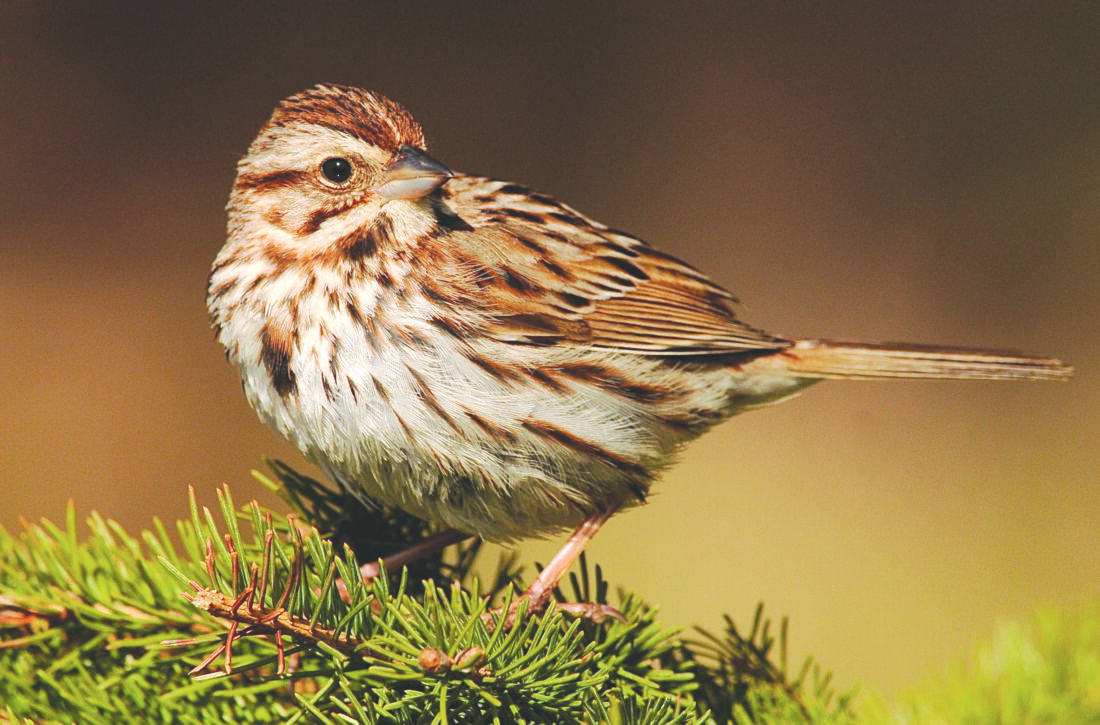
This song sparrow finds a perch in a local fir tree. (Photo courtesy Scot Stewart)
Hearty common grackles and red-winged blackbirds are also continuing their return. While their numbers continue to be small in most places, a few flocks have arrived. At Portage Point south of Escanaba, a good-sized flock of 85 red-winged blackbirds was found on Monday.
Also seen in through the wetlands there the same day were a pair of mute swans, six sandhill cranes and a ring-necked pheasant among the 21 species witnessed that afternoon.
The Chocolay River has also produced a number of good sightings in the past week. The number of northern pintail ducks rose by one to three this week, seen with a double-crested cormorant, a bufflehead, a pair of ring-necked ducks and a gadwall along with all the regulars, including 114 mallards in one count.
Currently the Mackinac Straits are seeing some of the biggest numbers of waterfowl so far in the U.P. as ducks, geese and swans are on the move through that area.
Fifteen species were tallied by a waterfowl counter at Graham Point near St. Ignace in Mackinac County. They are sponsored by the Mackinac Straits Raptor Watch, based in Petoskey. Top on the list were 1,170 redheads and 151 common goldeneyes. Also seen were gadwalls, ring-necked ducks, scaup, buffleheads, all three species of mergansers and a pair of trumpeter swans. Altogether, 41 species were seen during the six-hour count that day.
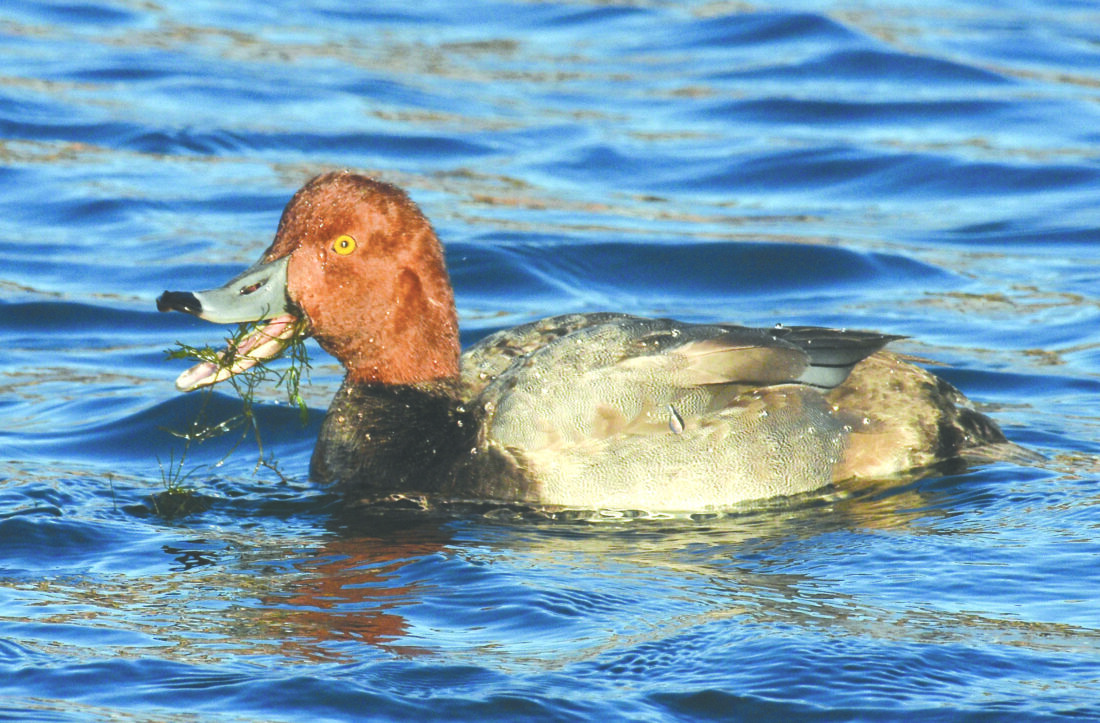
This is a redhead duck feeding in area waters. (Photo courtesy Scot Stewart)
Another waterbird counter is at work at Whitefish Point in Chippewa County. The Point is at the narrowest crossing point to cross Lake Superior on the way to Canada, without having to fly all the way around the east end of the lake over Sault Ste. Marie. That counter has been in place since March 15, including being out during the last big blizzard. During those two days, only a few American herring gulls were seen on the move, along with several local birds like chickadees and blue jays.
This counter is positioned on a deck in the sand dunes to the west of the lighthouse where the counter watches to the southwest for raptors — hawks, falcons and eagles, plus turkey vultures. The count begins in mid-March due to the early passing of both golden and bald eagles.
Merlins have been the most common falcons seen with just a few American kestrels watched passing through on their way to Canada. Rough-legged hawks, overwintering from the Arctic overwinter are among the first hawks to head north. Red-tailed hawks and American goshawks are also frequently seen already. Turkey vultures have been reported at several U.P. sites, including over the Tourist Park in Marquette last Monday.
When the sunnier, warmer weather comes, there will be more songs to join those of the northern cardinals, mourning doves and house finches.
A number of song sparrow arrivals has been noted through eBird reports throughout the U.P. They have one of most musical songs of all the sparrows here during the summer and sing nearly the entire time there are here for the breeding season.
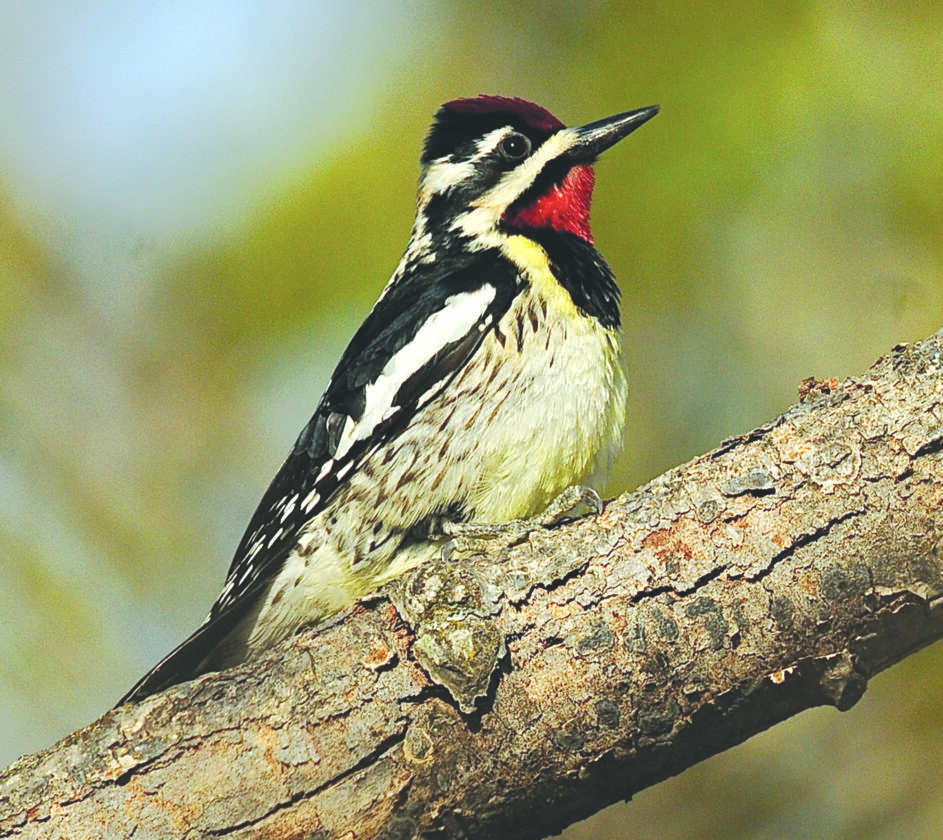
This is a yellow-bellied sapsucker on a local tree limb. (Photo courtesy Scot Stewart)
They do identify good nesting sites and will use the same one year after year, even if a new pair takes over a territory. They are prodigious breeders and have been known to raise as many as four clutches of young in one summer.
Their relative abundance adds to the impact these singers have across their summer range. During breeding season, their range covers nearly all of the southern half of Canada and most of the eastern and western thirds of the U.S. They have found nesting sites all along Lakeshore Boulevard through Marquette, and a slow drive from Founder’s Landing north to Wright Street can turn up multiple morning songs in spring.
Marquette’s peregrines are back, too. If successful, this would be at least the 16th year they have nested in the city. For more than half that time, peregrines were able to nest in boxes provided at the two power plants along the lake in town. Once those facilities came down, the falcons had to look elsewhere for nesting sites. A new box was placed on one of the roofs of the new hospital and it was used, but not last summer.
Peregrines have also turned to natural cliff sites to nest as well. Currently there are several sites they have used from Pictured Rocks and Grand Island in Alger County westward to Big Bay back in Marquette County.
Other recent reports have included an American woodcock at Quinnesec in Dickinson County this week and a yellow-bellied sapsucker seen in Marquette.
With the weather still transitioning slowly, the new arrivals will probably come just as slowly. But when those warm stretches do arrive — look out, it could be spectacular.
Friday: Outdoors
DNR’s U.P. fishing report

People and animals alike, ready for spring to arrive
Birds emerge as slowly as the snow melts
What’s Flying: New bird arrivals give hope to the coming of spring

Outdoors North: My own version of “Four Thirty-Three”
DNR weekly fishing report
Little Bay de Noc: Anglers reported slow fishing when targeting perch and attributed the slow fishing to the cold ...