
Trump’s promises to Black voters fall short
Trending
WASHINGTON -- At one of his final rallies before the 2024 election, then-candidate Donald Trump warned that Black Americans were losing their jobs in droves and that things would get even worse if he did not return to the White House.
“You should demand that they give you the numbers of how many Black people are going to lose their job,” Trump said. “The African American population, they’re getting fired at numbers that we have never seen before.”
But with Trump back in office since January, an already fragile financial situation for Black Americans has worsened. Upset by inflation and affordability issues, Black voters had shifted modestly toward the Republican last year on the promise that he could boost the economy by stopping border crossings and challenging foreign factories with tariffs. Yet a recent spate of economic data instead shows a widening racial wealth gap.
Black unemployment has climbed from 6.2% to 7.5% so far in 2025, the highest level since October 2021. Black homeownership has fallen to the lowest level since 2021, according to an analysis by the real estate brokerage Redfin. Earlier this month, the Census Bureau said the median Black household income fell 3.3% last year to $56,020, which is roughly $36,000 less than what a white household earns and evidence of a bad situation becoming worse.
That creates a major political risk for the president as well as an economic danger for the nation because job losses for Black Americans have historically foreshadowed a wider set of layoffs across other groups.
“Black Americans are often the canary in the coal mine,” said Angela Hanks, a former official at the Consumer Financial Protection Bureau and the Labor Department who is now at The Century Foundation, a liberal think tank.
The Trump White House stressed that some of these downward trends, such as a relative decline in Black wealth, began under Democratic President Joe Biden. It emphasized that the “diversity, equity and inclusion” policies pushed by Democrats failed to deliver economic gains.
“Despite his lunatic obsession with DEI, Joe Biden’s disastrous economic agenda reduced the Black share of household wealth by nearly 25%,” said White House spokesman Kush Desai. “His inflationary policies caused interest rate hikes that froze Americans out of homeownership, and his open borders policies flooded the country with tens of millions of illegals who drove down wages.”
More hurt than help
Some Black voters who stayed on the sidelines in 2024 feel they need to be more engaged politically.
Josh Garrett, a 30-year-old salesperson in Florida, said he could not find a candidate last year with whom he agreed. He is frustrated by Trump’s layoffs of federal workers and sees a government more geared toward billionaires than the middle class.
“I don’t understand how you could be for the American people and have Americans lose their jobs when they have families, have bills,” Garrett said.
While the financial outlook for Black Americans is deteriorating, the net worth of white households is largely holding steady or increasing, largely due to stock market performance.
Hanks notes that the “chaotic effects” of Trump’s tariffs and spending cuts are hitting more vulnerable populations right now but that the damage could soon spread beyond.
Black leaders critical
The federal layoffs appear to have disproportionately hit Black Americans because they make up a meaningful share of the government workforce. The administration maintains that its income tax cuts, tariffs and deportations of immigrants who are in the United States illegally will help Black Americans, but there is little evidence so far in the data of that.
At the same time, Trump has said that he would like to deploy the National Guard to Chicago, New Orleans, Baltimore and Memphis, Tennessee -- cities led by Black mayors. The president has called for redrawing congressional districts to favor Republicans, which could dilute the ability of Black voters to shape elections. He has sought to diminish the legacy of slavery and segregation from the Smithsonian museums.
“The message that they are sending is very clear: In these places, these people are incapable of governing themselves,” Baltimore Mayor Brandon Scott said. “They are incapable of helping to solve their own issues. And make no mistake about it, it’s partly due to how we look.”
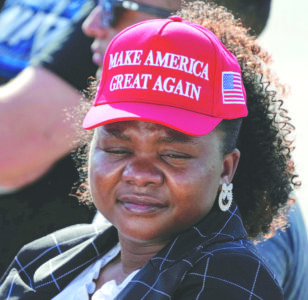
A supporter arrives before President Donald Trump speaks at a rally on July 3 in Des Moines, Iowa. (AP file photo)