
Pain explained
Trending
MARQUETTE -- Ever wondered what role the brain plays in the perception of pain?
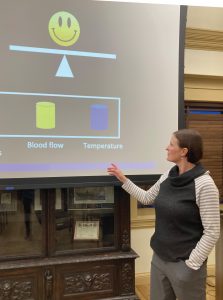
Liz Peppin, a physician's assistant who is part of Marquette Internal Medicine's neurology staff, held a presentation titled "The Neuroscience of Pain" for the Northern Center for Lifelong Learning at the Peter White Public Library on March 9.
"Pain is necessary for survival," Peppin said to kick off the presentation. "We have over 400 nerves that are identifiable and named. If you put them all from end to end, they would go from Marquette to Munising. They're all connected like highways, and every single nerve in our body has a baseline electrical charge."
So, how does pain work? Peppin explained a theory that was suggested by philosopher Rene Descartes around 300 years ago.
Descartes' theory posited that something bad happens, pain occurs, and nerves tell the brain about it. His model was ultimately incomplete, but doctors believed it at the time because it seemed to make sense.
However, Louis Gifford's mature organism model, developed in the 1990s, gave a more detailed description about how pain works in the body.
"He said that the nervous system is always watching what's going on, and when something happens in the tissues … that information then goes into our nervous system and gets processed," Peppin said. "Out of the nervous system comes a decision about what to do about that information. Like if my hand is on the hot stove, I want to take it off."
There are different types and categories of pain.
Acute pain, Peppin said, is pain that occurs for less than three months and is a normal experience. The purpose of this pain is protection from danger.
Conversely, chronic pain is pain that lasts more than three to six months, and is common but not normal. About one out of three people in the U.S. have chronic pain, Peppin noted.
"As far as we can tell, chronic pain has no physiological purpose whatsoever. It does nothing for us, unlike acute pain, which is a protection from danger," Peppin said. "It's sort of a bad habit of the nervous system."
Peppin went on to describe the three categories of pain: nociceptive, peripheral neuropathic, and central sensitization.
Nociceptive pain is acute pain that is usually associated with tissue injury, such as an ankle sprain, paper cut, or broken bone. Nerves in the tissues send messages to the brain telling it something concerning is happening, the brain then recognizes that signal and creates pain to cause a reaction, such as pulling a hand away from something hot.
Peripheral neuropathic pain involves nerves in the peripheral nervous system, which consists of the nerves located outside the brain and spinal cord. This pain occurs when damaged peripteral nerves become more sensitive. Instead of giving the brain information about only dangerous situations, these damaged nerves send the brain information about things that aren't dangerous. This means there a person can experience ongoing pain in the absence of painful outside stimulation. This type of pain can occur in an individual with diabetes who has had nerve damage.
Another category of pain is central sensitization. It is pain that lasts longer than three to six months and is the reason for most chronic pain, such as fibromyalgia or painful osteoarthritis. This pain occurs when the nervous system as a whole becomes too sensitive and responds to things that aren't dangerous as if they were dangerous. The problem is primarily in the central nervous system, which is the spinal cord and brain.
"It feels like everything hurts," Peppin said. "People often describe it as deep, aching, and sometimes burning."
Peppin explained that pain can't be truly measured, as everyone experiences pain differently.
The pain scale charts in doctor's offices -- which typically show the one-to-10 pain scale with the happy face above the one and the sad face above the 10 -- aren't very effective and not realistic.
"We cannot measure pain because it's a subjective experience," Peppin said.
Instead of asking someone to rate their pain on a scale of one to 10, she said it's more effective to ask, 'How does pain effect your ability to live your life? or 'How does pain effect your ability to do the things you want to do?'
How these different types of pain be treated?
"Effective treatment looks different for everyone," Peppin said. "Each person has to think about and define what is effective."
Medications can be helpful, and injections and surgery may be needed for certain issues.
Other options include physical therapy, occupational therapy, aquatherapy or aerobic exercise. Opioid treatment is also an option, but Peppin cautioned that there is very rarely a role for it.
"Pain is more neurological than mechanical," she said.
Thoughts, beliefs, emotions, depression, anxiety, relationships, socioeconomic status and behaviors all have an effect on pain, not just what's going on in the body.
There are four main things that need to happen in order for pain to improve: one has to understand why they're hurting, sleep has to improve, there needs to be exercise or some form of movement, and one must have goals, Peppin said.
"At the end of the day, pain does not mean that you are broken," Peppin concluded.
The Northern Center for Lifelong Learning is a group that involves its members planning, coordinating, and providing various informal educational programs and events throughout the year.
Membership and programs are open to any adult who enjoys learning and new experiences. Membership dues are $30 for the year, with a $3 charge for most classes for members, or $10 for nonmembers.
Gift certificates are available for those wishing to purchase a membership for friends or loved ones. For more information on the NCLL, visit: www.nmu.edu/ncll.
Taylor Johnson can be reached at 906-228-2500, ext. 248. Her email address is tjohnson@miningjournal.net.