
Gone fishin’
Winter angling through ice at issue
Trending
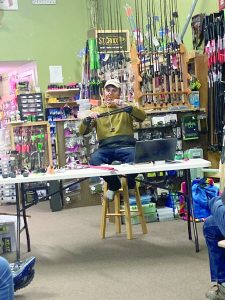
MARQUETTE -- Superior Outfitters and the Northern Center for Lifelong Learning teamed up on Nov. 30 to present Fishing 101, an informative class all about fishing.
Nick Symon, owner of Superior Outfitters, located at 209 S. Front St., put on the presentation to a dozen members of the NCLL. Symon grew up in southern Michigan and has been fishing since he was a child.
"Northern Michigan has a lot of great fishing opportunities," said Symon.
Ice fishing was the first topic of discussion. If visiting a spring-fed lake to ice fish on, be very cautious of thin ice. It is recommended to fish with a few other people, and to let others know where you'll be fishing. It is also suggested to bring a compass when going out.
OnX Hunt, a phone app, can help plan a fishing trip by showing river levels as well as public and private land data, fishing access sites, boat launch sites, routes to the intended destination, and aerial imagery. Always check fishing guides or consult the DNR to know what types of fish are legal to catch during the year.
If ice fishing very early in the season, Symons cautioned, "if you're a beginner, just don't do it. I recommend waiting until there is five or six inches of ice if you're in an unfamiliar body of water."
Spud bars are a helpful tool when ice fishing. Spud bars are a long bar with a chiseled end that one uses to hit the ice with to check if the ice is thick enough.
If the spud bar goes through the ice in a couple hits, the ice isn't thick enough. Ice picks are another suggested tool to have, in the event of one falling through the ice. The picks will help one crawl out of a hole.
"There are quite a few lakes in the Gwinn area that are going to have a lot of people out on them, if you're going to try ice fishing for the first time, that would be a good place to go. Go to lakes that are heavily trafficked and see where people have been, start there," Symon said.
Tip-ups are another tool that can come in handy when ice fishing. Tip-ups help to hold bait in a set depth of water through a hole in the ice. There is a flag on the tip-up that will pop up when a fish has taken the bait. Michigan law states that tip-ups must have the fishers name and address somewhere on it.
What is the best part of a river to fish on when it isn't winter?
"In general, if you're just getting started, fish in spots where you can't see the bottom. If you can't see the fish, they're probably comfortable. You want to fish log cover, dark bottom holes, look for water four feet or deeper. Pay attention to grass, too. There are sections of a river that are only three feet deep that people walk right by, but fish can tuck in the grass," according to Symon. Deer Lake in Ishpeming is a good place to practice fishing for beginners, as it is a catch-and-release site only.
Staying calm and quiet is an advantage when doing any type of fishing.
"If you can stay out of the water in any fishing situation -- do it. Walking into the water isn't giving you any advantages, other than telling every fish around you, 'Hey I'm here'. They can feel you in the water," Symon said.
Thermometers are a great tool to help save time, as they indicate if the water is too warm for certain type of fish. If the water is too warm, one can make the decision to move on to a different spot to find fish.
When fishing, don't be deterred by a fish's natural looks. Burbot fish are a great example of this.
"Burbot are horribly ugly. They're native to Lake Superior and some of Michigan's inland waters and they're an indication of a healthy water system. They're one of the best table fare in Michigan and best caught at night," Symons said.
It is important to be aware of what type of fish one is consuming. Mercury levels, especially in basins, can be high.
"A two-year-old walleye is going to have less contaminates in it than a 12-year-old walleye," said Symons.
In general, the longer lipped predator species should be avoided.
Navionics, another phone app, can help keep track of one's fishing routes, mark previously fished locations, and show the depth of waters. The DNR is also a great resource to find maps for where to fish, species information, rules and regulations, fishing guides and more.
Taylor Johnson can be reached at 906-228-2500, ext. 248. Her email address is tjohnson@miningjournal.net.