
Weather fascinates: U.P. weather is fascinating
“Change in the weather, change in the weather; somethin’s happenin’ here. Change in the weather, change in the weather, people walkin’ round in fear.” — John Fogerty
For all our world’s collective advancements in weather forecasting, satellite imagery, climate science, storm mapping, and even efforts to manipulate the winds, rain and snow as weapons of war, some of the simplest notions have remained with us over the centuries.
Among them, humans continue to be fascinated with weather, the changing seasons and Mother Nature’s tremendous power to defy well-trained meteorological forecasters, civil engineers and learned politicians.
Some folklore idioms, farmers’ traditions and other weather predictors from bygone eras remain with us, still vibrant to this day.
Last month, we had Groundhog Day, when the eyes of the world, and thousands of the nation’s morning television news and weather teams, were trained on a tiny Pennsylvania town to behold the prognostication of a celebrated marmot — which is held high for the cameras by a man who wears a black suit, derby hat and sometimes, a heavily-waxed handlebar moustache.
However, despite all this attention, there appears now to be controversy among some in the Keystone State as the weather is proving, so far, to be seemingly far more spring-like than the groundhog predicted — for shame!
But there are so many other mammalian predictors of spring weather outside the woodchuck named Phil who hails from the Quaker State — with a success rate of 65 percent.
There’s Chattanooga Chuck in Tennessee, Woodstock Willie in the Illinois town where the movie Groundhog Day was filmed, even Schubenacadie Sam in Nova Scotia. In Michigan, Woody, at the Howell Nature Center, agreed with his Pennsylvania cousin in predicting six more weeks of winter — again, for shame!
This month, we have March expected to “Come in like a lion and go out like a lamb,” or so the old idiom contends. Like the guessing groundhogs, it appears to be wrong this year, at least in the Upper Peninsula anyway.
However, chasing the origin of this phrase reveals some interesting notions.
One is astronomical, based on the positions of where the constellation Leo (the Lion) is at the beginning of the month, compared relatively to the constellation Aries (the Ram) at the end of March. But wouldn’t that make it, “In like a lion, out like a ram?”
“Some have pointed out that Jesus arrives as the sacrificial lamb, but will return as the Lion of Judah. Which, weather-wise, means a false spring,” said Sadie Stein, contributing editor of The Paris Review, in a story on the topic from a couple years back.
Stein writes that one of the earliest citations of the phrase is found in Thomas Fuller’s 1732 compendium Gnomologia: Adagies and Proverbs; Wise Sentences and Witty Sayings, Ancient and Modern, Foreign and British.
That tome also includes other idioms Stein mentions on March including “So many mists in March you see / So many frosts in May will be” and “A peck of March-dust, and a shower in May, makes the corn green, and the fields gay.”
In Oklahoma, the state’s Cooperative Extension Service says, “Before improved animal husbandry made lamb available year-round, lamb meat was only available in spring. For that reason, lamb was associated with spring and called ‘spring lamb.’ Spring is the time when most farm animal babies are scheduled to be born.”
The Farmers’ Almanac suggests the saying is seemingly among those rhymes or beliefs of “people who came before us,” rather than a “true weather predictor.”
“Those people often believed that bad spirits could affect the weather adversely, so they were cautious as to what they did or did not do in certain situations. Those beliefs often included ideas that there should be a balance in weather and life. So, if a month came in bad (like a lion), it should go out good and calm (like a lamb),” the Almanac said. “With March being such a changeable month, in which we can see warm spring-like temperatures or late-season snowstorms, you can understand how this saying might hold true in some instances.”
And in the Upper Peninsula, many residents are familiar with the notion of the St. Patrick’s Day snowstorm — another idea passed down faithfully each year, but not necessarily a true weather predictor.
The Almanac also lists other March-related lore including “A dry March and a wet May? Fill barns and bays with corn and hay,” and “As it rains in March, so it rains in June.”
And what about next month, “March winds and April showers? Bring forth May flowers.” Does that hold true if it’s “raining cats and dogs?”
Editor’s note: Outdoors North is a weekly column produced by the Michigan Department of Natural Resources on a wide range of topics important to those who enjoy and appreciate Michigan’s world-class natural resources of the Upper Peninsula.
Friday: Outdoors
DNR’s U.P. fishing report

People and animals alike, ready for spring to arrive
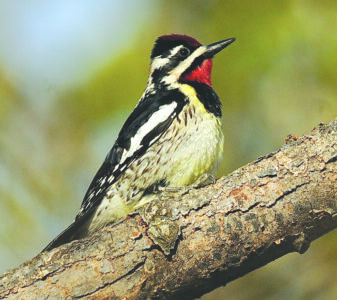
Birds emerge as slowly as the snow melts
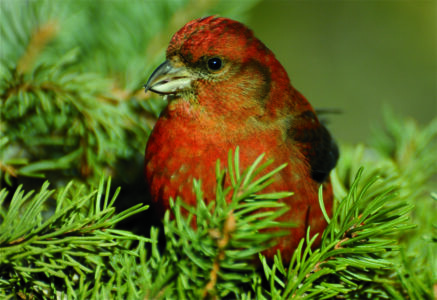
What’s Flying: New bird arrivals give hope to the coming of spring

Outdoors North: My own version of “Four Thirty-Three”
DNR weekly fishing report
Little Bay de Noc: Anglers reported slow fishing when targeting perch and attributed the slow fishing to the cold ...