‘Cost of Addiction’ focuses on families
Panel discussion connects professionals, community
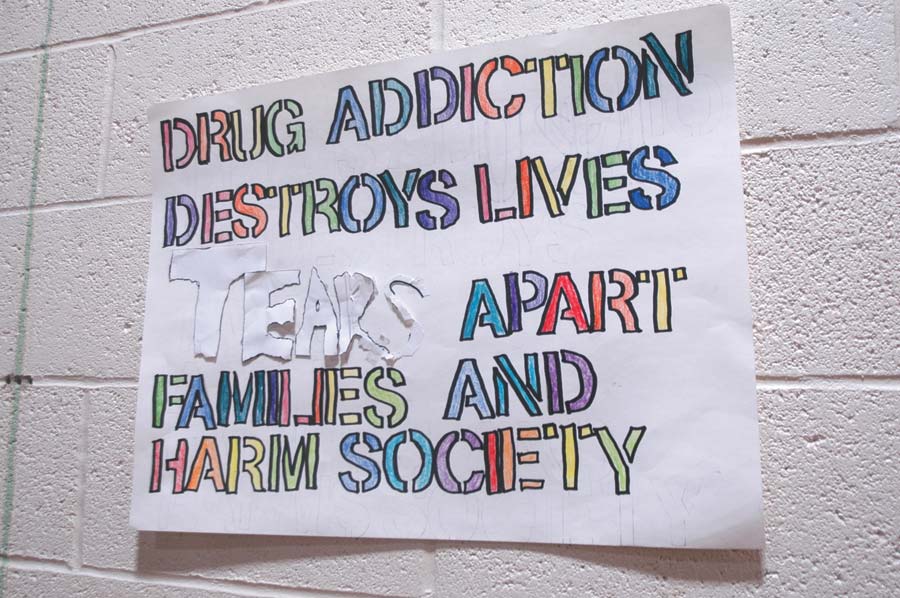
This poster, created by students at Marquette Alternative High School at Vandenboom, decorates the gymnasium wall as an appropriate message for Wednesday’s panel discussion, “The Cost of Addiction: Family Strategies.” The focus was on families coping with loved ones with substance abuse disorders. (Journal photo by Christie Bleck)
-
- This poster, created by students at Marquette Alternative High School at Vandenboom, decorates the gymnasium wall as an appropriate message for Wednesday’s panel discussion, “The Cost of Addiction: Family Strategies.” The focus was on families coping with loved ones with substance abuse disorders. (Journal photo by Christie Bleck)
-

- These are Negaunee Middle School winners in the “I Can” video contest. From left are Michael Adams, Hayden Anderson, teacher Derek Cardinal, Bryce Storms, Chase Collick, Kendyl Dahlstrom, Jackson Gladwell, Kate Randall, Dayna Gagnon, Morgan Vaughn, teacher Michael McCollum and Kaelyn Amis. (Photo courtesy of MARESA)
To address this part of the issue, a panel discussion entitled “The Cost of Addiction: Family Strategies” took place Wednesday at Marquette Alternative High School at Vandenboom. The program was the second of a five-part series on addiction.
Talk focused on substance abuse addiction’s cost to families and communities.
“This is such an important topic in so many ways to our community,” said Andrew Crunkleton, MAHS principal. “Opioid drug abuse use, pharmaceutical drug abuse — it’s really wreaking havoc in our nation. It seems anytime you turn on the news, in cities somewhere across the country or even right here at home, that there’s an overdose or an issue with a medication not being available to help individuals.”
He has first-hand experience with the issue, having seen adolescents with the problem and losing close friends to overdoses.
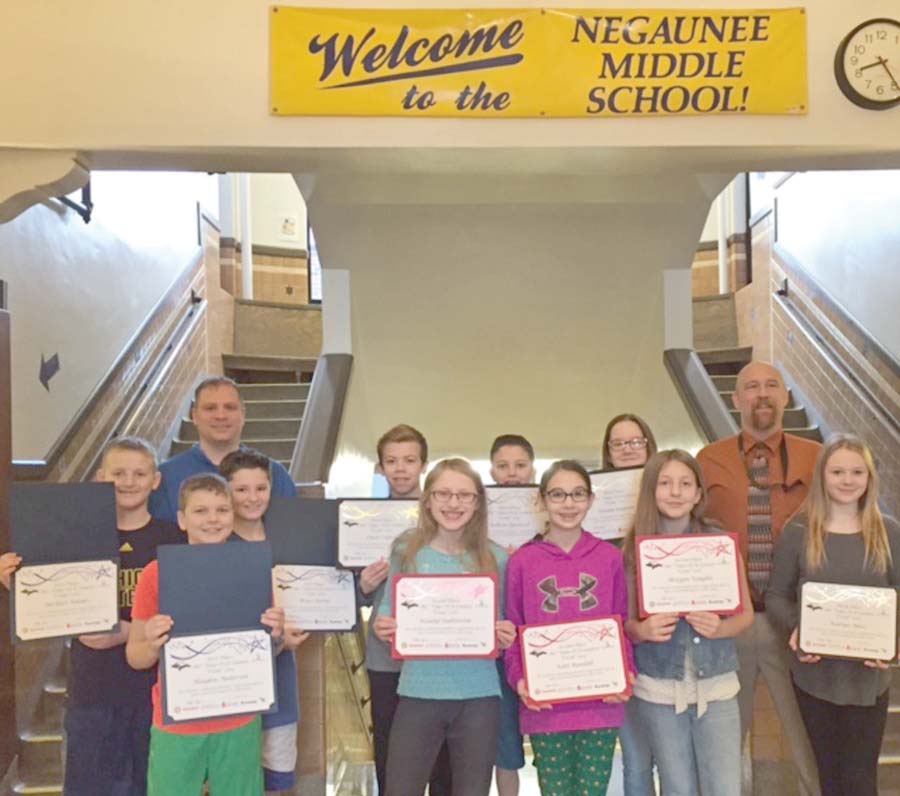
These are Negaunee Middle School winners in the “I Can” video contest. From left are Michael Adams, Hayden Anderson, teacher Derek Cardinal, Bryce Storms, Chase Collick, Kendyl Dahlstrom, Jackson Gladwell, Kate Randall, Dayna Gagnon, Morgan Vaughn, teacher Michael McCollum and Kaelyn Amis. (Photo courtesy of MARESA)
“I made a pledge over the summer to myself that I was not going to stand quietly and watch this happen to people that I love and care for, whether that be my students or my own family,” Crunkleton said.
That concern helped lead to the “Cost of Addiction” series.
Gery Shelafoe, prevention services coordinator for the NorthCare Network, was one of the speakers at the Wednesday program. She had audience members take part in a role-playing session with “live sculptures” in which they were a school superintendent, convenience store owner or newspaper editor, for example, who were either taking a risk or being protective in dealing with the addiction issue.
The crowd had to decide to which categories the people belonged after they read statements on how they deal with certain situations.
One problem was that the people were so focused on the adolescent that they were ignoring the risk factors for the community, Shelafoe said.
This is where a group of people can make a difference.
If that coalition stands up to the convenience store owner to say it doesn’t want her to sell certain products to an underage patron, that would be a big help, she said.
“Everybody has risk in their lives,” Shelafoe said.
Paul Olson, a therapist with Great Lakes Recovery Centers, talked about the levels of substance abuse disorders regarding symptoms, triggers and responses.
These can be interpersonal.
“None of us exist in a vacuum,” Olson said. “We all exist with people around us, and families. There’s things that impact the family and things that we can do to protect people.”
He explained that a substance abuse disorder can be considered mild if there are two to three symptoms, moderate if there are four to five and severe if six or more symptoms exist.
Symptoms themselves differ in severity, from things like cravings and failing to fulfill major life roles to placing themselves in physically hazardous situations. Triggers include parties, depression, anxiety and unemployment.
When triggers lead to increasingly serious symptoms, the families’ responses can escalate as well, he said.
“Family members at first might be unaware of the problem,” Olson said. “They might see some funny behavior, not quite sure what it means. Might be kind of confusing.”
They might attempt to solve the problem, or take on the user’s responsibilities.
Then it gets worse as they have begin to have knowledge of the problem, and eventually back off.
“They start to pull away, and they start to avoid the problem,” Olson said.
Guilt can be another result.
“Everything that goes right or wrong to people we care about, we bring it back to something we did or didn’t do, so then that’s how families start to get sucked into this guilt and shame,” Olson said. “There’s a lot of guilt and shame around substance abuse.”
Resignation and hopelessness then set in, along with enabling, which he acknowledged can be difficult for an outsider to understand.
“As a person is starting to develop more and more symptoms of substance abuse disorder, then it gets harder and harder to confront,” Olson said. “Defense mechanisms start to become more elaborate.”
It then becomes difficult for a family to address the problem head on, and it can “fold under the pressure,” he said. So, it becomes easier to enable the user.
However, he said family members can get “sucked” into the situation through that enabling.
And desperation can be the result, which Olson said can lead to family members becoming concerned about legal and health consequences and being ready to do anything to keep the status quo.
One solution, according to Olson, is setting healthy boundaries.
“We don’t use people, we don’t abuse other people and we don’t let other people use or abuse us,” Olson said.
They do want to stay involved, he acknowledged. So, participating in their treatment can help.
“We know the outcomes are better,” Olson said. “Families need to understand what recovery is.”
Another speaker was Marquette County Sheriff Greg Zyburt, who for 32 years was police chief of Chocolay Township.
“As a police officer, we try and be proactive,” said Zyburt, who noted there are things parents can look for to determine if their kids are substance abusers.
Throughout the years, he’s read many books and gathered a lot of information on the subject, which include the following tips for parents: looking for a dry mouth, oversleeping, bloodshot eyes and a loss of interest in activities that once interested the kids.
Parents should look for these and other signs when their kids become adolescents, and know who’s coming to their homes and watching out for theft, he said.
“You know your children better than anyone,” Zyburt said. “You know what they were like before.”
Wednesday’s forum also focused on local students getting involved in fighting the drug problem — visually.
The Marquette County Substance Abuse Prevention Coalition, or MC2, challenged students in middle and high school as well as college to make 30- to 60-second public service announcement videos in the “I Can” competition, which were judged for cash awards.
About 50 students submitted 15 videos whose themes were anti-substance abuse.
Winners are: middle school, first, Michael Adams, Hayden Anderson and Bryce Storms, Negaunee Middle School, $500; second, Kendyl Dahlstrom, Kate Randall and Morgan Vaughn, NMS, $150; and third, Chase Collick, Jackson Gladwell, Kaelyn Amis and Dayna Gagnon, $150.
High school: first, Evan Hassell, Travis Nelson, Hannah Skewis and Bobby Williams, Negaunee High School, $500; second, Ty Koski, Keegan McGonigle, Cody Niskanen and Brandon Rogers, $200; and third, Maria Hoenke and Kelsey Ampe, home-schooled, $100.
College/Northern Michigan University: first, Drew Boggemes and Kayla Bell, NMU, $500; and second, Kevin Paczesny, Chris Yang, Mathew Key and Nicole Moore, NMU, $100.
MARESA health coordinator Kelly Sager said of the young videomakers: “It’s not cool being the kid at school who says, ‘Don’t do drugs.'”
Christie Bleck can be reached at 906-228-2500, ext. 250. Her email address is cbleck@miningjournal.net.