
Memory jug a famous African-American art form
Trending
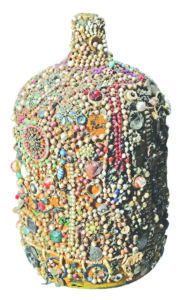
Can you put a price on memories? This memory jug sold for $1,125 at Slotin Folk Art Auction. Memory jugs like this one, with decorative items embedded into the surface, are a famous African-American art form. They are believed to have originated in central and west African traditions, where graves are decorated with broken objects or vessels of water.
Broken objects are said to represent the breaking point between the afterlife and the land of the living, allowing the deceased's spirit safe passage. Water was believed to be the path to the spirit world. Enslaved Africans continued practicing their traditions in the United States, adapting them to the resources that were available and teaching them to their descendants.
"Memory jug" came to mean a jug or similar vessel coated in a layer of clay with small decorative items, like buttons, beads, keys and shards of glass or pottery, pressed into it while it is still wet. The one pictured here, made by an unknown artist, is covered in beads and bits of jewelry. The art form spread outside African-American communities in the 19th century, fitting in well with Victorian sentimentality.
Today, crafters can easily find instructions for creating their own memory vessels; not as grave markers, but as a way to use and display tiny trinkets, souvenirs and found objects, akin to a three-dimensional scrapbook. In this case, "memory" refers more to mementos than to memorials. Still, when talking about an art form that preserves memories, it is especially appropriate to keep its origins in mind.
*******
QUESTION: I have an antique upholstered chair that I believe is from the late 1800s. I'm sure it has been reupholstered since then, and I would like to restore it to its original appearance. How can I find out how it originally looked and have it restored?
ANSWER: It will probably be difficult to determine how your chair originally looked. Your best chance is probably to consult a furniture restorer in your area. If you know the chair's manufacturer, you may be able to find one of their catalogs that would have information about the chair's original design. There are many antique furniture catalogs that have been scanned and made available online.
You are right that your chair has probably been reupholstered since the 1800s. Upholstery is subject to fading, wear and tear, and people have been altering antique furniture to fit contemporary trends for hundreds of years. Victorians had additional decorations carved into earlier, plainer styles; the 20th century saw the removal of these decorations to fit the simpler modern aesthetic; and today's thrift shoppers look for inexpensive vintage and antique furniture to repaint or reupholster as they please.
A tip for those of you who decide to reupholster old furniture: Save a piece of the original fabric, put it in an envelope, and tape it to the bottom of the seat. Not only will this let a later buyer know about the original fabric, but it will also increase its value.
*******
QUESTION: My porcelain tea set has an unusual mark on the bottom of the pieces. There is a row of Chinese characters, and underneath it reads "Made in China." I have not seen a mark in both Chinese and English anywhere else. Can you tell me the significance? Does it mean anything about the value?
ANSWER: The mark helps date your tea set. Items imported by the United States were required to be marked with the name of the country of origin in the 1890s. The words "Made In" were used by the 1910s. Marks like the one on your tea set, written in both Chinese and English, were common in the mid- to late 20th century. The Chinese characters also mean "Made in China."
There are many variations of these marks; for example, some have the characters written in a straight line, and some in an arc. Sometimes the mark includes a number or letter to identify the date or pattern. Because your tea set was probably made within the last 50 years, based on the mark, and likely mass-produced for export, it would probably resell for a fairly low price, likely under $100. However, that would depend on the size of the set, its condition and its pattern.
*******
TIP: Tufted Victorian pieces covered in dark velvet need to be dusted in each tuft, a time-consuming process. Consider reupholstering without tufts, a style also done in Victorian times.
*******
CURRENT PRICES
Current prices are recorded from antiques shows, flea markets, sales and auctions throughout the United States. Prices vary in different locations because of local economic conditions.
Toy, pull, Gabby Goofies, large duck wearing hat, three smaller ducks, round wings, each on wheels, multicolor, wood, cord, Fisher-Price, c. 1960, 5-by-13 inches, $35.
Photography, darkroom timer, round dial, Start/Stop switch, metal casing, red, adjustable, Eastman Kodak, 5 1/2 inches, $90.
Chinese Export, plate, Famille Rose, center flower vase, flower sprays around rim, gilt trim, 18th century, 9 1/2 inches, $125.
Clothing, cape, embroidered, center peacock, flower borders, two front panels, magenta ground, fringe border, silk, Victorian, 80-by-84 inches, $160.
Batman, bookends, Batman, Robin, standing, flexing arm, city skyline background, name on base, marked, National Periodical Productions, 1966, 6 inches, $180.
Bronze, bowl, shallow, narrow rim, ring foot, patinated, marked, Just Andersen, Danish Modern, 9 3/4 inches, $270.
Disneyana, display, advertising, Disneykins, Disneyland Castle, three tiers, 15 Cents Each, easel back, 34 figurines, Marx, c. 1960, 20-by-20 inches, $600.
Furniture, chair, Model 1938 Swivel, Gio Ponti, aluminum, steel, vinyl, perforated back and seat, painted, casters, metal tag, Kardex for Montecatini, 1936, 30 3/4 inches, $665.
Glass-Venetian, vase, Simirone, bulbous, red and blue swirls, short flared neck, tapered base, faceted glass stand, signed, numbered, Alessandro Mendini, Venini, 25 3/4-by-15 inches, $1,330.
Porcelain-Chinese, vase, bottle shape, blue and white, dragons, flared neck, short foot, six-character mark, 11 inches, $2,300.
*******
Originating as grave markers as they now are vessels covered in fragments of decorations, memory jugs developed from African traditions into a unique American art form. (Photo courtesy Slotin Folk Art Auction)
You’ve seen the Kovels Antique Trader magazine. Now get the online newsletter every week for free! Kovels Komments brings together the antiques expertise and enthusiasm for collecting of two beloved brands. Keep up with what’s new in antiques, see prices from notable sales and find out what kinds of questions your fellow collectors are asking. And don’t forget to test your knowledge with #whatsitwednesday, the longtime Kovels feature that challenges you to identify quirky, odd-looking and obscure antiques! Register for free on Kovels.com or AntiqueTrader.com and look for Kovels Komments in your inbox every Wednesday.
Kovels answers readers’ questions sent to the column. Send a letter with one question describing the size, material (glass, pottery) and what you know about the item. Include only two pictures: the object and a close-up of any marks or damage. Be sure your name and return address are included. By sending a question, you give full permission for use in any Kovel product. Names, addresses or email addresses will not be published. We do not guarantee the return of photographs, but if a stamped envelope is included, we will try. Questions that are answered will appear in Kovels Publications. Write to Kovels, (Name of this newspaper), King Features Syndicate, 300 W. 57th Street, 41st Floor, New York, NY 10019, or email us at collectorsgallery@kovels.com. Copyright 2026 by Cowles Syndicate Inc.