
Torreano had plenty of WWII adventures while defending America
Trending
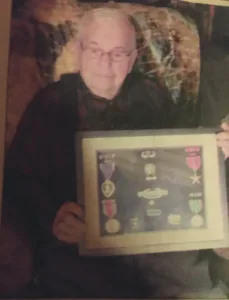
This is World War II veteran John Torreano holding a display of the medals he earned during his military service. (Photo courtesy Virginia Paulson)
World War ll veteran John Torreano should be honored for his service to his country. He received two Purple Hearts and a Bronze Star for Valor.
Torreano enlisted in the army in October 1941 and was discharged in October 1945. He served as a soldier in the 82nd Airborne Division, 505th Parachute Infantry Regiment. Torreano was a member of the first "jump school" class.
Being a parachute jumper appealed to him because they got paid more than regular infantry. That was double pay, which was $50 extra per month.
Torreano was one of two men from the Upper Peninsula in the paratroopers, the other Dominic Luca. Torreano talked him into joining up because after he enlisted he felt lonely going off by himself. Luca was captured on the first jump and was a prisoner of war in Germany for two years.
Torreano's overseas service started in 1943 when his unit went to Casablanca, Morocco. Torreano said the missions involved 13 to 15 men jumping out of a plane at a time. It was a dangerous operation, even in peacetime. There were a lot of broken legs because you can’t predict where you are going to land, especially in combat.
The soldiers carried about 150 pounds of gear on their backs, including weapons and land mines, and very little food. They had sea rations, which really were crackers and dried Spam.
Torreano was a prisoner of war for a short time in the mountains of Italy. He was in charge of a five-man patrol when he saw a German patrol of the same size going behind a ridge formation. Torreano's patrol tried to get around them, but the German patrol said, "Comrade, we've been waiting for you."
The Germans took five American men prisoners for a few uneventful days. Torreano's men were able to escape from the Germans when the U.S. Air Force started dropping bombs and heavy machine gun fire from low-flying aircraft. Torreano's men made a run for it and got away.
In September 1943, part of Torreano's unit went to a rest camp in Ireland. From there, they went to England where they trained for the invasion of Normandy and then fought in the Battle of the Bulge.
Torreano's friend was Ray Barr, who had a 2-year-old son, and he told Torreano, "Nothing will keep me from going back to my boy." But Barr was killed in Normandy.
Many of the men were married. A number of the men were guys who were in prison and the governors of certain states gave them a pardon if they joined the service.
Torreano said the hardest part of war was watching others suffer. He had befriended an elderly English couple and they had lost everything.
A difficult time for Torreano was near the end of the war. They jumped in Holland. The mission was to take over a bridge to cut off a German retreat. The jump took place on a Sunday afternoon.
Half of Torreano's company had become isolated from the other soldiers because they landed on the other side of the river. The soldiers couldn't get across because of constant gunfire. They waited until midnight when it was dark and they expected the Germans to be asleep.
At midnight they brought in some rubber dinghies for the men to come across the river. When they were half way across, the Germans got wind of it and threw some spotlights on the river and opened fire. All the men trying to cross the river lost their lives. Torreano witnessed the onslaught.
He had malaria five times. During a stay in a hospital in Naples, Italy, for a bout of malaria, Torreano was called on to make another sacrifice.
The post office was blown up at the noon hour. When people were rushing out, a bunch of American soldiers got hit. Orderlies in the hospital were looking for volunteers to donate blood. He said he would donate but he wanted them to know that he had malaria.
The orderlies didn't care because the blood was more important at the time. When Torreano asked who received his blood, he was told it was a man from the Upper Peninsula of Michigan.
The man was from Ishpeming. Torreano saw him many times. The man had lost a leg and walked with a cane. Torreano didn't regret his time serving his country.
Torreano lived to the age of 98 and died on Feb. 15, 2019, according to an online obituary from the Koskey Funeral Home.
Virginia Paulson has been a trustee with the Negaunee Historical Society for more than two decades, previously having been on the Negaunee Public Schools board of education for 23 years and MARESA board for 17 years.