
Nearby Gwinn has boom, bust history with mining, military
Trending
We received a package at the Negaunee Historical Museum, and an article about Gwinn was in the mix. I found it interesting and thought other readers would enjoy the information from it
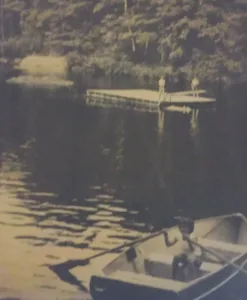
This is a scene of yore from the Gwinn Tourist Park. (Photo courtesy Virginia Paulson)
Gwinn, called the "model town," was developed by the Cleveland Cliffs Iron Mining Company.
Iron ore was discovered shortly after the Civil War in what was known then as the Swanzy Range by Silas C. Smith.
In 1871, Jonas Pearce of Sharpsville, Pennsylvania, opened the first mine. He named it the Smith Mine, which later was changed to the Cheshire Mine. Pearce opened the Mitchell Pit in 1872, which was later purchased by Cliffs and renamed the Princeton Mine.
Soon after this purchase, Cliffs opened the Austin, Stephenson, Gwinn, Kidder and Francis mines. These discoveries of ore would require a large number of employees. Warren H. Manning, a prominent architect and landscape artist, was hired in 1906 and the town began to develop. Manning planned the town to be built on an island set in the midst of tributaries of the Escanaba River. He planned a tree lined boulevard and park to give it beauty.
William Gwinn Mather, president of the company, named the town Gwinn, as a tribute to his mother, whose maiden name was Gwinn. Mather also built a community center, with a well equipped gymnasium and swimming pool and recreation rooms. The mining company built a bank, hotel and a hospital. All commercial buildings had to be built with fireproof brick or stone.
School buildings were built in all mine locations. Five churches were built to serve Catholics, Methodists, Swedish Methodists, Finnish Lutherans and Episcopalians.
The first business that opened in the community was a store operated by Richard Quayle; Quayles block was located on the most prominent corner in the business district. It later became Frank's Super Market.
Peter Koski and Co. opened a general store in the Gwinn Hotel building, which also had a drug store. This became the Gwinn Inn bowling lanes. Other businesses were Rosenblum's Clothing, Johnson's Saloon, later Gwinn Bottling Works and Dave's Tavern. Winter and Suess operated a grocery store in Princeton.
New Swanzy boasted several businesses, including Negrinelli's, Musatto's and Ghiardi's grocery stores. A large roller skating rink and opera house were also located in New Swanzy.
Adolph Peterson had a photography studio and then went into the candy and soda fountain business. He also operated a tavern and ran the theater.
The mining company built 55 double houses for their employees in Gwinn. Each mining location -- Princeton, Austin and Cyr -- also had houses built for employees. There were also single houses built for mining officials.
The early miners could have their family medical needs taken care of by paying a doctors' fee of 50 cents a month. The local hospital was operated by the mining company and also charged low rates. Dr. Donald McIntyre was head of the hospital.
When the mining industry in the area began to falter, employees were transferred to other mines in the area. Many families remained in Gwinn and commuted to their new places of employment.
With the arrival of K.I. Sawyer Air Base in 1955, many changes took place. New businesses were opened and many new homes were built. The school district felt the impact. The school enrollment went from under 500 students to 3,000.
In 1897, the school district had three teachers and 82 students. In contrast with Sawyer Air Base in the area, there were 171 employed on the professional staff and 70 nonprofessionals in the 1969-70 school year.
Long after the mines have vanished, think of Warren H. Manning and William Gwinn Mather, who planned this "model town" with its tree-lined boulevard.
Virginia Paulson has been a trustee with the Negaunee Historical Society for more than two decades, previously having been on the Negaunee Public Schools board of education for 23 years and MARESA board for 17 years.