
Artemis 2 marks our grand return to Moon

Graceyn Kitchel
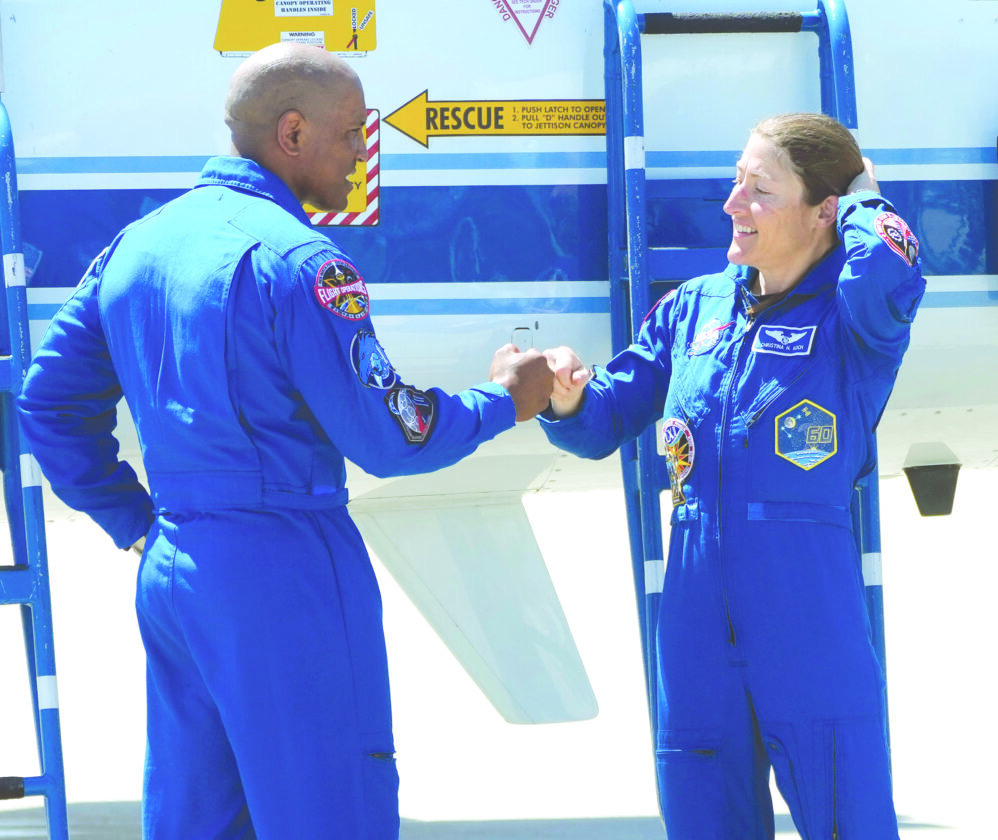
A pair of Artemis 2 crew members, pilot Victor Glover, left, and Mission Specialist Christina Koch, fist bump after the crew's arrival at the Kennedy Space Center on March 27 in Cape Canaveral, Fla. (AP file photo)
Graceyn Kitchel
A pair of Artemis 2 crew members, pilot Victor Glover, left, and Mission Specialist Christina Koch, fist bump after the crew's arrival at the Kennedy Space Center on March 27 in Cape Canaveral, Fla. (AP file photo)
Trending
This year is a grand year of record-breaking history already, since this is the first time in over 50 years that humans have returned to the Moon.
Space exploration has begun again! This new spacecraft, Artemis 2, has traveled from Earth, around the Moon, and back.
The crew on this mission broke many records, including traveling farther from Earth than any other humans, passing the 248,655-mile record set by Apollo 13. They traveled 252,756 miles on this mission, surpassing the Apollo 13 record by 4,101 miles.
A second notable aspect of this mission is that it was the first mission beyond Earth's low orbit, the orbit closest to Earth's surface, only extending 99 miles from the ground, to include a woman as a crew member, someone who is not an American citizen, as well as a man of African-American/Caribbean-American heritage.
To honor this unique change in crew history and to acknowledge the 300,000-plus people who contributed to the humongous effort that went into building the spacecraft, the crew named their capsule "Integrity."
We all know that fuel is getting more and more expensive, and the fuel for Artemis 2 was no exception. Although spacecraft fuel is relatively inexpensive for companies like NASA or SpaceX, it still takes hundreds of thousands of dollars to fuel a single launch. This is why Artemis 2's flight path was shaped roughly in a figure-eight. This is called a free-return trajectory. This flight path circles around the Earth and then out and around the Moon, and once almost around the Moon, with the Moon's gravity snapping the spacecraft back to the Earth.
This method not only saves fuel but also ensures that the astronauts will return home safely even if the main engine fails, as there will be no need for extra propulsion on the return home.
Artemis 2 was very different from the first time that humans went to the Moon for many reasons. The most recognized reason is that this time, none of the astronauts landed on the Moon. Instead, on this mission, the astronauts performed a flyby so that they could study and chart different craters on the far side of the Moon.
Many people, myself included, were confused about why they were using human eyes and humans to perform this advanced flyby, as robots seem more accurate and efficient. NASA has explained that in this case, humans were more adept for this particular mission because we have high sensitivity to color and texture changes that robots simply cannot replicate at the moment.
The main goal of this mission was to test and evaluate the performance of the deep space exploration system, as well as test life-support systems for the future and far more dangerous missions to the Moon and eventually to Mars.
All these goals required human testing to be truly accurate, it seemed only right that the astronauts of this mission would study the flyby as well. This flyby allowed these amazing astronauts to see and observe the Moon from nearly all sides and observe a list of 30 surface targets, including the Orientale Basin, which is a nearly 600-mile-wide crater located on the Moon's far side that extends over to the near side. It is a 3.8 billion-year-old crater formed when a very large object struck the Moon, and even today, it still has remnants of the collision.
Spacecraft and the knowledge we have about space are only growing and advancing in accuracy, and the grand success of the Artemis 2 mission marks a monumental turning point in this journey.
With the grand groundwork officially laid for the upcoming Artemis 3 lunar landing, humanity is proving that anything can be accomplished if we put aside differences in gender, race, nationality, etc., and work together.
Graceyn Kitchel enjoys many things, the main three being reading, any cat, but specifically hers, and martial arts. She loves to walk around Marquette, where she has lived her entire life, and go to the library with her buddies. Her favorite daily accessory is her Red Converse shoes.