
State police in U.P. have origins in World War I, miners’ unrest
Trending
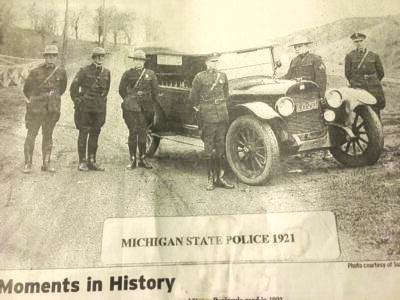
This is the photo, cut out from a past edition of The Mining Journal, referenced in today’s Historically Speaking article. (Photo courtesy Virginia Paulson)
Several state police troopers stand with their patrol car on a rural Upper Peninsula road. This picture was actually taken at the west end of Iron Street in Negaunee, where the police post was located right in that area of the fence.
The road going uphill is the road to the Jackson Mine. The road also went to Cornish Town, also known as Michigan Street, where many of the miners settled. On the right is the railroad track for shipping ore. That is now part of the Iron Ore Heritage Trail.
The staff at the Negaunee History Museum was not aware of the Michigan State Police story until John Maga's grandson brought us many pictures and his grandfather's story. I submitted the story several years ago to The Mining Journal, and it was printed, but it bears repeating.
The Michigan State Police, a most respected law enforcement agency, had its area Negaunee beginnings in 1917. It was known as The Constabulary. The United States declared war against Germany and its allies, entering what would become known as World War I. A few days later, Michigan National Guardsmen were headed for the battlefields of France.
Left without men to guard the homefront, on April 10, 1917, the state created an emergency force, "The Michigan State Troops." This was the birth of the state police force.
Negaunee residents felt the effects of the war on the home front with the unexpected arrival of troops who came home unannounced, arriving on the Duluth Express during early morning hours. State "soldiers" came to relieve a threatening situation in the mining region. Their post was established in the west-end area that was called Cornishtown Road.
America was not at ease at the onset of war because of espionage, sabotage and labor unrest. Serious labor problems were threatening the iron mining industry. Industrial Workers of the World, the IWW, was causing unrest on the Gogebic Range, and it was feared that it would move to the Marquette Range.
Rumors of a strike were rampant. With a war going on, iron ore was needed for the war effort. This was not a good time for miners to strike. According to the Iron Herald, an affidavit was circulated and signed by thousands of citizens, including a huge majority of miners affirming their loyalty to IWW. The strike failed to materialize and the detachment of 30 troops stayed in Negaunee and set up temporary headquarters and pitched their tents.
The Iron Herald noted that they were trim, young fellows and their equipment was complete for any kind of duty they may be called to perform. They had short-barrel rifles, revolvers and riot sticks. The fledgling force was established in Negaunee and a crew of men were put to work extending water pipes and electric wires to the campsite. The local mining company built a cook shed and a mess hall. A cook stove was hauled in by wagon. Carpenters from another mine built an ice chest and a telephone was installed.
Such was the beginning of the first post in Upper Michigan. In 1919, The Constabulary became the Michigan State Police.
Prohibition in 1919 provided new challenges. The manufacture and sale of alcoholic beverages became illegal. Locally, saloons were boarded up and miners were thirsty for their nickel beer. Prohibition bred corruption and the term "bootlegger," the seller of illegal beer, became a household word.
Negaunee served as the headquarters for the troops until a major riot and escapes from the Marquette Branch Prison occurred in 1921. The troops had headquarters on U.S. 41 near the Department of Natural Resources office until 1973.
They later moved back to Negaunee and were housed in the Jones and Laughlin Research Lab at the Tracy Mine site. They remained there until their move into their present headquarters on U.S. 41 in Negaunee Township.
Virginia Paulson has been a trustee with the Negaunee Historical Society for more than two decades, previously having been on the Negaunee Public Schools board of education for 23 years and MARESA board for 17 years.