
Italy’s Ladins bring own attention for Olympics
Trending
MILAN -- Italy’s Ladin minority settled a millennium ago in the Dolomite mountain hamlet of Anpezo -- now the two-time Olympic host city of Cortina d’Ampezzo. But members of this ancient ethnolinguistic group are disappointed that the Winter Games will not spotlight their culture.
Instead, Ladins will wave their flag themselves, both figuratively and literally, with a series of initiatives sharing their identity with visitors -- and not just in Cortina, but across all of Ladinia, the Ladin-speaking region that spans five Dolomite valleys and three of Italy’s four Olympic territories.
Ladin leaders expected Milan Cortina Olympics organizers would reach out to feature their language and traditions that exist only in Italy, just as organizers have done in previous host cities, from Lillehammer to Beijing.
When they didn’t, mayors of all 17 Ladin towns sent a letter soliciting that representation, but received no reply.
“We are cut out, as if we don’t exist,” said Elsa Zardini, head of the Ladin community in Cortina.
Cortina’s Ladins
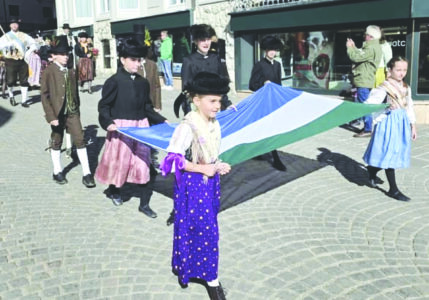
Wood carvers and stewards of the forest, Ladins have lived in the Dolomites for 2,000 years. Their legends include the story of Laurin, king of the dwarfs, whose curse is said to have bestowed the region’s dramatic pale limestone peaks with their pinkish sunset glow. For religious ceremonies, they wear traditional costumes including colorful dresses and headpieces for women.
Ladin is a Romance language, formed when the Latin of Roman conquerors blended with ancient Rhaetic. The U.N.’s cultural agency lists it as endangered, with just 35,000 speakers. About 2,500 of them live in Cortina, half the town’s population. Its mayor is half Ladin; his mother, from Genoa, didn’t want him to learn Ladin for fear it would interfere with his Italian.
Ladinia spans three of the four territories hosting the Games: Veneto, home to Cortina, which will host curling, sliding and women’s Alpine skiing, as well as the autonomous provinces of Alto Adige and Trentino, which are hosting biathlon, cross-country skiing, ski jumping and Nordic combined.
Slalom skier Alex Vinatzer, competing in these Games, is Ladin. So is former Olympic figure skater Carolina Kostner, who won bronze in 2014, and downhill skier Kristian Ghedina, a five-time Olympian.
Not in opening
People carry a traditional Ladin flag during a parade through the streets of Cortina D’Ampezzo, northern Italy, at an unspecified time. (ULdA, Ampezzo Ladin Union via AP)
When Ghedina went to Lillehammer in 1994 to compete in the Winter Games, the Artic Sami people were featured in the opening ceremony. In Sydney in 2000, Indigenous Australian Cathy Freeman lit the caldron. And four years ago, Beijing -- even with its record of suppressing some ethnic groups -- showcased all of China’s 54 ethnic minorities.
But Milan Cortina’s 2 1/2-hour opening ceremony on Friday will not include the Ladins, local organizers confirmed, but will celebrate Italian beauty and culture, including fashion, design and music.
“We want to celebrate those elements that have been exported all over the world,” the opening ceremony’s creative director Marco Balich told The Associated Press.
Even before this perceived slight, the Games were a sore spot for the Ladins of Cortina.
The 1956 Olympics went a long way toward propelling the once-Ladin majority town into a luxury resort replete with luxury fashion boutiques. Today, Ladins struggle to hang on to inherited property due to the increased value and the corresponding inheritance tax. Many young Ladin families move away -- tearing at the cultural fabric.
At the official Olympic events, both in Cortina before the Games begin, Ladins will enjoy just two appearances.
A pair in traditional dress were on hand for the arrival of the Olympic torch on Monday, invited by the town. However, they didn’t appear in any images shared by the local organizing committee. And before the Olympic opening ceremony, a small group of costumed Ladins will parade through Cortina -- footage that will not be broadcast with the main ceremony, which will reach millions across the globe, local organizers told the AP.
Shining spotlight
That left Ladins to find other ways to raise their own profile.
Zardini is handing out Ladin flags -- their azure, white and green colors representing the sky, snow and meadows of their mountain landscapes -- to anyone wishing to display one during the Games. Her initiative has spread to neighboring South Tyrol and Trentino provinces.
“It isn’t so much a protest as a welcome, so visitors realize that a people living here speaks a certain language and has its own traditions,” she said. “That is our intention. And then, some have of course displayed it in protest.”