
What’s Flying: Summer has turned ‘back to school’
Trending
"This morning, the sun endures past dawn. I realize that it is August: the summer's last stand." – Sara Baume
Summer has turned to "back to school" for many -- children and adults alike, but here in the Upper Peninsula, there is still a week or two of unofficial summer left and maybe a little bit more of real summer. It never really did dazzle residents in the U.P. this summer with blazing temperatures, but much of life, adapted for the summers here apparently made it through successfully.
One of the best places lately to catch late summer families has been on Cornerstone Drive in Marquette Township. A family of wild turkeys was seen along the road last weekend with around ten very young poults. The young were barely a foot tall, so they were from a late hatch and were just off the road, still learning the ropes of navigating along busy roads.
This past Wednesday a family of sandhill cranes was observed rooting through the front lawn of an office also right along the road. This family seems very comfortable around humans, not only feeding on roots and invertebrates in the grass but wandering through the parking lot just as individuals were leaving for the day.
Large families of house finches and chickadees have continued on at area feeders as late families of these also fledge. Some young rose-breasted grosbeaks have also continued at feeders too. Yards have been filled with multiple families of crows to this week with as many as ten showing up in school fields in south Marquette as recent rains have drawn worms and other invertebrates to the surface.
A few birders were on the Peshekee Grade this week in western Marquette County and they found evidence of young families there too. One birders listed 21 ruffed grouse on their bird tally earlier this week.
This week marked a big push southward of migrating songbirds. One species seen this week is a bird taking much of its life in opposite fashion from other birds. While most songbirds settle in and sleep during the night, common nighthawks live up to their name by heading out at sundown to begin most nights hunting for insects. Usually around the third week of August they begin of heading out for South America for the winter. Although most range maps show their summers are supposed to be spend across nearly all of the Lower 48 and parts of Canada, their numbers have dwindled considerably and are difficult to find across the U.P. in summer.
Unlike many songbirds migrating at night, they are often seen in late afternoon and early evening and are especially visible along the Lake Michigan shoreline from the U.P. through Wisconsin during migration. The largest group reported last Monday was of several hundred over Spalding in Menominee County. These were seen flying low quietly heading southward.
As migration does ramp up some reverse flights do occur. One recently brought a great egret to northern Marquette County this week. In recent years the breeding population of egrets has increased along the Menominee River along the Wisconsin-Michigan border. Some, possibly younger, nonbreeding birds do wander northward, turned around with their internal navigation, some maybe looking to explore new spots to expand their summer range. This one did stop at a lake edge to hunt before disappearing.
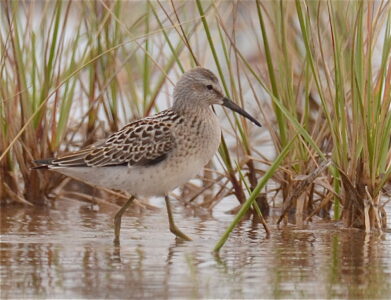
Migration has shown some new developments this week too. On Wednesday fifteen different species of shorebirds were seen at the tip of Whitefish Point in Chippewa County. There were many of the species seen earlier this late summer, but several notable species were seen. A whimbrel was found at the point as was a stilt sandpiper. A ruddy turnstone, piping plover, three buff-breasted sandpipers, and nine pectoral sandpipers were also seen there during the eight-hour count period. The water's edge near the tip has a rather unique shoreline of rounded pebbles and with recent storms a considerable number of insects are blown into the water and wash up on the pebbles where the birds find them. The tip also contains several shallow pools where larger shorebirds like the stilt sandpiper and yellowlegs are often seen foraging.
Turkey vultures have been more prominent in the Marquette area this past week with a number seen coasting over Marquette Township and the western part of the city. Single birds, pairs and a trio of these gliders have been followed as they look for food along the roadways.
One place where some great birding should be happening soon is in area's mountain ash trees. This summer has produced a bumper crop of fruit, weighing the branches of many trees considerably. The fruits on many are nearly ripe and will attract migrating robins, gray catbirds, Swainson's, hermit and gray-cheek thrushes, scarlet tanagers, and some species of warblers. By locating bird baths with water for the birds to drink and other feeders with suet and sunflower seeds nearby, a great diversity of birds is possible. In some of these places the larger number of birds utilizing the mountain ash fruits will also leave a good share of seeds as they are eating and may add to the future of these trees nearby. Birders can take a look at the leaves of mountain ash and other trees like serviceberry and encourage them in their yards to increase the bird numbers in their yard in years to come. Nothing like an early start to improving birding in the future.
Scot Stewart is naturalist at the MooseWood Nature Center, a writer and photographer.