
History comes alive with firing of Lyle gun
Trending
By TRINITY CAREY
Journal Staff Writer
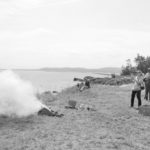
MARQUETTE -- To celebrate the 228th anniversary of the U.S. Coast Guard, the Marquette Maritime Museum fired their historic line-throwing Lyle Gun on Saturday.
The gun, invented in 1877 by U.S. Army Captain David Lyle and first used by the U.S. Life-Saving Service Crews, shoots a line over ships that wrecked within 400 yards from the shore. The line was pulled in until victims of the shipwreck could reach it. One person at a time was then pulled into safety, explained Maritime Historian and Volunteer Frederick Stonehouse.
During the event, the Lyle gun was shot using an ounce of gunpowder making the line shoot about 150 yards from the shore, but at full capacity, the gun has the power to shoot 600 yards using 8 ounces of gunpowder.
"It really is a small cannon. They would use it in the course of a season perhaps five or six times authentically, so there are thousands of people that were saved because of this device," Stonehouse said.
The Lyle gun was last used in May of 1953 in Marquette when a large freighter, The Maryland, was driven onto the sandbar off Chocolay Beach. The Coast Guard used the gun to bring 24 men to safety while a helicopter rescued the last 11.
"So you had this unique circumstance of the first time a helicopter ever did a Great Lakes rescue like that, moving people from a sinking ship, and at the same time using the oldest technology on the same shipwreck," Stonehouse added.
A member of the U.S. Coast Guard displayed the current version of the line gun--an M16 dual purpose firearm with an attachment to shoot a line, which can be removed quickly to also fire bullets.
The annual event gives people the opportunity to not only hear about the past, but to see and experience history first-hand while honoring the men and women of the Coast Guard, Stonehouse said.
"If we don't know where we were, we don't know where we are," Stonehouse said. "If you can make history come alive, and this is a way of doing that, you can get people interested in it. It's when you reduce it to nothing but flat displays and dull books and even worse teachers that it doesn't happen."
Trinity Carey can be reached at 906-228-2500, ext. 243. Her email address is photos@miningjournal.net.