
Big jet landing
Antonov An-124 Jet touches down at Sawyer International Airport
Trending
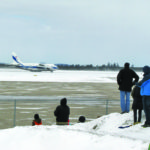
MARQUETTE -- One of the world's largest aircraft, the Russian Antonov An-124 jet arrived at Sawyer International Airport at 12:37 p.m. Wednesday from Stewart International Airport in New York, with spectators of all ages braving the cold, windy afternoon to see the massive jet land.
The aircraft, operated by Volga-Dnepr-Unique Air Cargo Inc., is designed to carry heavy cargo, and made the trip to Sawyer to pick up a South Korean helicopter, which has been at the airport for around six months.
Airport Manager Duane DuRay said it took until "well after 5 p.m." to load the helicopter onto the Antonov An-124.
The Antonov An-124 left Sawyer at 2:57 a.m. today to depart for Anchorage, Alaska -- a 2,634-mile trip, DuRay said. The jet will then travel to South Korea to deliver the helicopter.
The South Korean helicopter was stationed at Sawyer because Korean Aerospace Industries, along with the South Korean army, has been working with the U.S. Army to perform de-icing tests on the helicopter at the airport.
However, DuRay wants to clarify that this was not a military operation, as many had perceived it, due to the involvement of the U.S. and South Korean armies.
"It's just assumed, seeing how (the helicopter is) painted military colors and the U.S. Army is doing testing, it's a military operation," he said. "It really isn't. It's a branch of the U.S. Army that helps aircraft manufacturers get certified in known icing flight operations."
DuRay explained further: "The U.S. Army has a branch of the service that works with individual companies, or aircraft manufacturers to help them get the data so that those manufacturers can get their aircraft certified for flying in known ice. Of course, the army has special equipment to create their own ice clouds … The primary role of the U.S. Army is to have the (equipment that) makes the ice clouds, so the aircraft can fly into the ice clouds safely."
DuRay noted that the helicopter, developed by the Korean Aerospace Industries, will be marketed for both civilian and military operations once it receives the certification.
He explained that the testing for certification for flying in known ice is a rigorous process.
"It's very, very scientific … They measure so many different variables on that aircraft, it's a very technical process," DuRay said.
The testing was a big job, as the operation brought around 60 individuals from South Korea and a U.S. Army base in Alabama to the area for five to six months, DuRay said.
He said the large number of people in the area to conduct the testing had a significant economic impact in the area.
These visitors patronized local restaurants, motels, gas stations and many other businesses in the area, which the U.S. Army estimated brought an economic impact "upwards of $2 million" to the area, DuRay said.
DuRay thanks the local community for its support and showing the visitors excellent hospitality while they were in the area.
"Their overall experience up here was very good and that deserves a kudos to the local community for being such a visitor-friendly area," DuRay said, noting that the visitors "truly enjoyed the area."