
Explaining quickly
Kilpatrick wins NMU’s Three Minute Thesis Competition
Trending
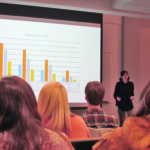
MARQUETTE -- Northern Michigan University hosted its very first Three Minute Thesis competition on Thursday, awarding first place and the People's Choice Award to Tianli Kilpatrick, a student pursuing her master's degree in writing, for her presentation, "The Immortal Jellyfish and Other Things That Don't Know About Love."
Kilpatrick will go on to the regional 3MT Competition, held in Grand Rapids on April 6 by the Midwest Association of Graduate Schools.
William Brown, a student pursuing his master's degree in clinical medical genetics, was awarded runner-up of the 3MT competition for his presentation, "Development of a Rapid HIV Diagnostic Assay using Isothermal Amplification Coupled with Peptide Nucleic Acid and Gold Nanoparticle Colorimetric Detection."
"The goal (of 3MT) is for students to talk about their thesis in three minutes with one slide," said Lisa Eckert, interim director of graduate education at NMU.
The 3MT competition, which is designed to help graduate students refine their research communication skills, got its start at the University of Queensland in Australia in 2008.
Since then, the 3MT has "become a worldwide hit," Eckert said.
It was initially aimed at Ph.D. students who were in the end stages of their dissertations -- students were challenged to condense the main points of their Ph.D. dissertations, averaging 80,000 words, into a three-minute talk.
However, 3MT has now been opened up to students pursuing master's degrees at the institutional and regional-level competitions -- this allowed NMU, as a master's degree-granting institution, to participate for the first time this year, Eckert said.
NMU's 3MT competition challenged graduate students from all disciplines -- with everything from exercise science to literature represented at the competition-- to clearly and concisely present their research to a lay audience with only three minutes and one slide.
The competition encourages researchers to leave their field-specific jargon at the door -- this is essential for being able to communicate the value of a complex project in any field to an audience with diverse academic backgrounds.
3MT can also help students to take a step back from the day-to-day complexities and challenges of research in their field and present the big-picture ideas of their research activities.
"When you have to explain it in three minutes, it forces you to decide exactly what you're talking about," said Kim Rosewell, a 3MT presenter pursuing her master's degree in literature, noting that she found it helpful to condense her thesis into a short presentation prior to defending her thesis.
Participants are judged on two broad categories: comprehension and content, as well as engagement and communication. Judges Dr. Alec Lindsay, professor of biology and chair of NMU's academic senate; Jason Nicholas, director of Institutional Research and Analysis; and Dr. Taylor Norman, a visiting professor in NMU's English Department, evaluated the participants on their ability to explain their content, avoid jargon, address research significance, engage their audience and convey enthusiasm for their research.
It's tougher than it sounds -- summing up months or even years of complex and highly specific research in just a few minutes is a true challenge, as student researchers need to have perspective on the larger significance of their work within the context of their field, avoid jargon, design a concise slide and speak quickly and effectively to their audiences -- lots and lots practice is key, participants said.
After the competition, participants said they were happy to see all of their practice pay off in their three-minute presentations.
Organizers said they look forward to continuing to hold the 3MT event in coming years and watching the competition grow -- they hope to encourage even more graduate students to share their research and creative works in the future.