
Doing it the RV way
Class learns the basics of recreational vehicles
Trending
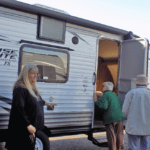
Cheryl Duer, RV consultant at Hilltop RV Superstore Ishpeming, shows a recreational vehicle at a Wednesday class of the Northern Center for Lifelong Learning. The class focused on the various types of recreational vehicles and what should be considered when buying one. (Journal photo by Christie Bleck)
ISHPEMING -- There are many ways of taking in the outdoors, some more rustic than others.
Backpackers probably would prefer sleeping in a tent, but not everybody has the physical ability -- or even desire -- to go that route. For some people, a recreational vehicle is the preferred way of enjoying nature, or even just traveling from one place to the next.
And with many more amenities.
But what kind of RV should they get? A class A motorhome or a pop-up?
Giving them information to make that choice, or just learn more about the RV world, was Dave Korpi, sales manager at Hilltop RV Superstore, who helped lead a class entitled "Is a Recreational Vehicle For You?" Wednesday at the business, located at 600 U.S. 41 West.
The class was sponsored by the Northern Center for Lifelong Learning.
"I don't care if you're an experienced RV person, when you go to an RV show and you have, you know, dozens if not hundreds of RVs, once you get done looking at them all, you don't remember which was which," Korpi said. "You're exhausted. You've been up and down a thousand stairs. You might have liked something, but you don't know where it was."
Wednesday's class was a generalized primer in a more-laid back setting to educate participants on RVs.
Korpi did, however, advocate some prior planning.
"One of the things that you want to consider if RVing is for you is: What type of camping or traveling will you do?" Korpi said. "You want to have the right unit to meet your needs."
An RVer could be someone who will use it three times a year, every weekend or even a full-timer, he said.
"We have people that sell their house, buy a big RV and travel," Korpi said.
In fact, Korpi said his store has seen a large segment of women who purchase a small, motorized vehicle, head south for the winter and come back.
People also should realize that an RV differs from a regular vehicle. It's an obvious distinction, but it's another factor people have to take into consideration.
"You need to know how to use this thing," Korpi said. "One of the things that we do here is we have an orientation. So, let's say somebody purchases a camper. You go back with one of the technicians that works and sets these things up day in and day out, and he's going to take an hour and half to two hours, three hours, whatever it takes, and goes through everything on the inside, everything on the outside, to make sure that you're comfortable and know how to use all of that stuff."
There is a lot of "stuff," depending on the RV, to discover.
What new owners have to learn are things like putting out slides and awnings, operating the televisions and radios, dumping the tanks and winterizing the vehicle, he said.
Korpi noted post-sale maintenance is another issue, pointing out that Hilltop RV is part of the Route 66 RV Network, which helps travelers connect with dealers that help them get back on the road within 24 hours of a problem.
Naturally, the class was curious about the RV market.
"I've seen this new wave of portable trailer, and they're so teeny-tiny, it's like, I guess they can sleep in it or something," said Judy Ashby, class liaison.
Korpi said Hilltop RV has those as well as other sizes. In fact, he went over the various types of RVs available on the market, which include:
≤ class A motorhomes, large vehicles that feature options like a combination washer/dryer and a full-sized refrigerator;
≤ class B and C motorhomes, with class B often referred to as a conversion van and class C distinguished by a sleeping bunk directly over the vehicle's cab;
≤ travel trailers, which are towable vehicles;
≤ fifth wheels, which are like travel trailers but lock into the pickup beds;
≤ pop-ups, which feature fold-up, lightweight designs; and
≤ truck campers, which sit in the backs of pickup trucks. Not using hitches, they can still tow additional trailers or equipment.
"It's a smaller market segment, but people like that," Korpi said. "They can tow a boat behind it or another trailer behind it. These are extremely popular for people taking trips to Alaska."
Ashby added: "And probably hunters too."
Other factors to consider when buying an ATV include towing, miles per gallon, where to park, camping costs, meals, insurance and connectivity for things like satellite TV and Wi-Fi.
Cheryl Duer, RV consultant at Hilltop, showed various vehicles on the lot to class participants.
Her favorite customers are first-time buyers since there are so many types of RVs that people don't know about until they've looked for a while, she said.
That's exactly what she let the class do Wednesday.
Duer allowed the participants to walk inside the RVs, some of which have features like spacious living areas and large kitchen counter space.
Selling an RV, though, can get kind of scientific.
"When somebody comes in to buy an RV, we're going to take and do some assessments on what their tow vehicles are, and you'll need a brake control on that, and sometimes you need weight distributions, which are all things we would train you in the RV lifestyle as far as doing it," Duer said.
Her jobs fits in well with her passion for the outdoors.
"I'm an avid camper, so I enjoy getting out," Duer said.
Christie Bleck can be reached at 906-228-2500, ext. 250. Her email address is cbleck@miningjournal.net.