Doctor gives talk at ‘Meet the Physicians’
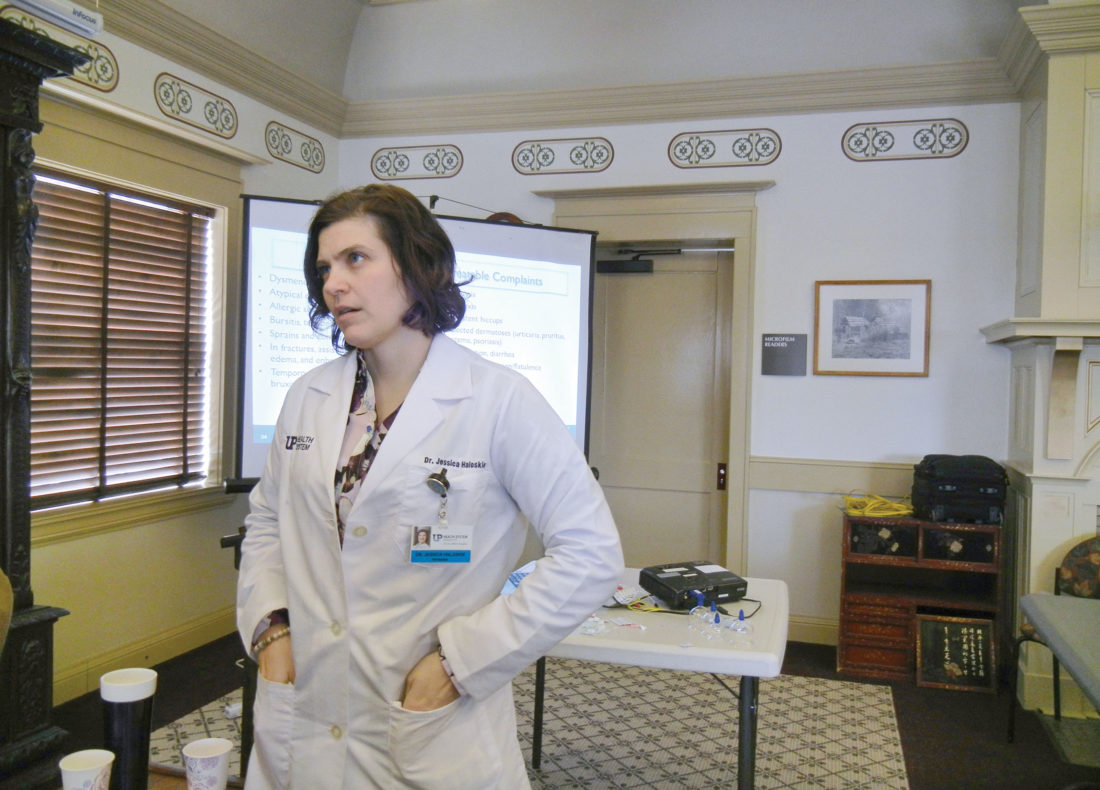
Dr. Jessica Haloskie of UP Health System-Marquette listens to people’s concerns about integrated medicine, the subject of her talk at a recent “Meet the Physicians” event at the Peter White Public Library in Marquette. Haloskie is board-certified in family medicine and acupuncture. (Journal photo by Christie Bleck)
MARQUETTE — Traditional medicine still is the go-to method of the typical physician, but sometimes it can’t hurt to mix in a little milk thistle or acupuncture.
Jessica Haloskie, M.D., of U.P. Health System-Marquette, talked about this facet of the medical field — integrative medicine — on Wednesday at a “Meet the Physicians” presentation at the Peter White Public Library.
Haloskie received her medical degree from Jefferson Medical College of Thomas Jefferson University in Philadelphia, and completed her residency in family medicine at the University of Pennsylvania Health System, also in Philadelphia. She is board certified in family medicine and acupuncture and is finishing her fellowship in integrative medicine at the Arizona Center for Integrative Medicine at the University of Arizona in Tucson.
Haloskie, who is married to UPHS-Marquette CEO Brian Sinotte, also has urgent care experience from her role as medical director of Urgent Care Services for Porter Regional Health System in northwest Indiana. She also has experience in occupational medicine from her role as medical director of occupational medicine and employee health at Porter Regional Health System.
Of her wide range of medical experiences, it was integrative medicine that was her focus of her talk.
“Basically, it is a way to build resilience,” Haloskie said. “There’s a lot of data showing that if you spend a few minutes every night writing three good things, three things you’re grateful for every night for 21 days, it has the same effect as an anti-depressant will for six months.”
That could be considered a less invasive — and less expensive — way to boost a person’s mood.
And those things can be as simple as getting pets to perform their morning evacuations, which was the case for Haloskie the day of her presentation.
It could be other events.
“Tonight you can write down, ‘I’m thankful that I had a great lunch. That Buddha Bowl I ate for lunch was awesome,'” Haloskie said.
Or: “I’m grateful and thankful that I just got to spend another day with someone I love.”
She stressed, though, that she still is a “normal” doctor.
“I will never tell you to stop your whatever medication that your other doctor or I feel you need,” Haloskie said. “I’ll never tell you to stop your chemotherapy. I’ll never tell you to stop your insulin.”
Haloskie, though, believes in the “integration” of other methods.
“There are times we need those Western medicines,” Haloskie said. “Can we cut down on them? Of course.”
Her fellowship in integrative medicine, she pointed out, is made to train physicians already involved in a medical practice but who want to add that extra component.
With integrative medicine, doctors use traditional Western medicine and weave in other parts of care.
“I look at them from their physical well-being for medical problems,” Haloskie said. “I look at their mental well-being and their spiritual well-being.”
After a talk with her patients, she recommends conventional tests and treatments she believes are needed, such as checks for Vitamin D and thyroid function.
They also discuss tailored dietary recommendations, botanical and herbal supplements, exercise, sleep, mind-body medicine and other techniques.
“It’s not just about a medical disease or a medical problem,” Haloskie said. “It’s also about wellness. It’s like, ‘How can I be in the best health I can possibly be?’ It’s not just about being sick, it’s about being well.”
For example, milk thistle can be used by people with liver problems while cinnamon can be used to treat diabetes, she said.
However, caution should be exercised and medical advice sought when taking these and other herbal supplements.
“You need someone who actually knows what they’re talking about,” said Haloskie, who noted interactions with other medicines need to be avoided.
She’s not trained in every part of integrative medicine, but others are, and integrative medicine components include things like Reiki, clinical hypnosis, meditation, music therapy, massage and chiropractic.
According to www.reiki.org, Reiki is a Japanese technique for stress reduction and relaxation that also promotes healing. It is administered by “laying on hands” and is based on the idea that an unseen “life force energy” flows through people.
“I’m not trained a Reiki practitioner, but I can recommend that,” she said of this form of “energy medicine.”
She does, however, have training in acupuncture.
That practice, which has been performed in China for about 8,000 years, involves inserting tiny needles into various areas of the body, she said.
“It’s basically calling your body’s own energy to the problem to help it fix it,” Haloskie said.
From a Western medicine standpoint, why does acupuncture work?
People aren’t sure, she said.
What is known, though, is that acupuncture changes a brain’s neurotransmitters, and as a result, lessens pain, she said. A body’s natural opioids also are being stimulated.
“It’s a great topic of research,” Haloskie said. “It’s very interesting to see different concepts come out.”
She can treat various ailments with acupuncture, with pain at the top of the list, and that involves headaches and back pain.
The list also includes conditions like anxiety, insomnia, allergic sinusitis, post-traumatic stress syndrome and even “phantom pain” that occurs after a limb’s been removed.
Unfortunately, Haloskie said insurance companies in the Upper Peninsula do not cover acupuncture. However, she said there is a 50 percent discount if a patient pays for the procedure the same day in her office.
She also talked about “cupping,” which came to some public notice at the 2016 Summer Olympics in Rio de Janeiro when star U.S. swimmer Michael Phelps was seen with strange, round red marks on his body.
Cupping involves using suction on a person’s skin that pulls the fascia layer, located over muscles, up to release tension.
She demonstrated cupping at her presentation.
“It looks kind of freaky, but it doesn’t hurt at all,” Haloskie said. “It actually feels good.”
The red mark results from the movement of blood flow, so women who have been “cupped” probably want to refrain from wearing a low-cut dress.
“I often do it in combination with my treatment,” Haloskie said. “I’ll do the acupuncture, and at the end, do this to help with pain.”
Haloskie, who practices at the Upper Peninsula Medical Center, 1414 W. Fair Ave., can be reached at 906-225-3864.
The next “Meet the Physicians” event is set for noon April 12 at Peter White Public Library. Physician assistant Bonnie Kilpela will talk on headaches and migraines.
Tuesday: Health
Talk With the Doc: Our pancreas is an essential human organ
Urology Pearls: Life and death in a quiet red hue

Our conscious and subconscious mind
Urology Pearls: To nap, or not to nap?
Talk With the Doc: March is Colorectal Cancer Awareness Month